Generative AI services: a 2026 buyer's guide
A 2026 buyer's guide to generative AI services — brand-controlled image, video, audio and multimodal pipelines, eval-graded outputs, and what the production pipeline actually costs.


Generative ai services are the layer of software that takes a creative brief (a product still, a brand film, a voiceover) and runs it through a stitched stack: a foundation model (Imagen 4 or Flux Pro 1.1 or SD 3.5 or Claude Sonnet 4), a routing layer (Fal or Replicate or Runware), a brand-asset store (Pinecone or pgvector), a delivery surface. What's shifted in 2026 is that generative ai services have stopped being one API call equals one asset and become real durable pipelines. A single deliverable now runs through 4 to 8 model calls, a retrieval step, a brand-safety filter, a human-review queue. That's the structural shift this guide is written around.
This is a 2026 buyer's guide for the Creative Director, the Brand Manager, the CMO, the Tech Lead evaluating generative ai services for a budget cycle that needs to ship a working pipeline this quarter. We'll skip vendor-marketing definitions and go straight to architecture shapes, the modality-by-modality vendor matrix (Imagen 4, Flux Pro 1.1, SD 3.5, Sora, Veo 2, ElevenLabs), a working code stack, the cost-per-approved-asset math, and the eight-step kickoff checklist. The bias is toward repeatable cost-per-shippable-asset.
Generative ai services in one paragraph, and why the 2026 stack looks different
Working definition. A generative ai service is a productionised workflow (multi-step, crossing 3 to 6 systems) where at least one step is a generation call to a foundation model like Imagen 4, Flux Pro 1.1, SD 3.5, Sora, Veo 2, Claude Sonnet 4, or ElevenLabs, and the orchestration survives a retry or a content-safety reject. That rules out a one-shot Midjourney prompt run by hand. It rules in a Figma-to-Imagen pipeline that respects brand tokens, a Diffusers worker running SD 3.5 with a per-brand LoRA, a Runway Gen-3 plus ElevenLabs chain producing a 6-shot social cut, a Claude-driven copy expansion pulling from a Pinecone brand archive.
Three things shifted between the 2023 image-gen wave and the 2026 generative ai services market. First, modalities went multi. Sora and Veo 2 made video generation a commodity ($0.50 to $1.50 per 8-second clip at draft quality). ElevenLabs and Cartesia did the same for voice. Second, the routing layer matured. Fal and Replicate and Runware now host hundreds of open-weight checkpoints behind one HTTP API. Swapping Flux Pro for Stable Diffusion 3.5 is one config line rather than a re-platform. Third, brand-control primitives shipped. LoRA fine-tuning on Flux Dev and SD 3.5 makes a brand-locked checkpoint a weekend of work. ControlNet plus IP-Adapter plus reference-image conditioning let a generated asset stay inside the brand sandbox. That's the headline reason new creative-ops budgets don't go to a single hosted vendor anymore.
We'll use generative ai services through this guide as the umbrella term for any production stack that combines durable orchestration with at least one foundation-model generation call, served either through a managed routing platform (Fal and Replicate and Runware, Together AI) or a self-hosted control plane (Diffusers plus ComfyUI workers behind n8n or Temporal). Where the trade-off between a single-vendor hosted path and a routed multi-vendor path matters for procurement, we'll say so. Our deeper companion note on the model-architecture trade between diffusion and flow-matching walks the technical comparison if you want to go a layer deeper on why Flux beats SDXL on certain prompts.
What counts as generative ai services, and what doesn't
The category boundary is where most buyer conversations go sideways. A vendor will pitch an Adobe Firefly seat as a complete generative ai services platform; a Canva Magic Studio rep will pitch a template library as the whole answer. Procurement needs sharper lines.
| Pattern | Counts as generative ai services? | |
|---|---|---|
| Designer runs Midjourney v6 by hand for one campaign | No orchestration, no retrieval, not repeatable | No. creative tool usage, not a service |
| Diffusers worker on Cloud Run with a brand LoRA, REST API in front | Durable, retrieval-aware, repeatable across briefs | Yes. canonical brand-locked shape |
| Adobe Firefly seat with template library, no API integration | Creative-tool layer, not a pipeline | Borderline. counts only if wired to a brand-asset store and a review queue |
| Replicate + Flux Pro 1.1 behind a thin Python adapter feeding a Notion DAM | Routed model + system-of-record write | Yes. agency-shipped flavour |
| ChatGPT wrapper that drafts press releases from a Pinecone archive | Foundation model + retrieval + write-back | Yes. text-modality flavour |
| Canva Magic Studio used by a marketing intern, no brand-asset wiring | Productivity tool, no orchestration | No. but rebadged in vendor decks as 'AI services', so check the wiring |
| Runway Gen-3 + ElevenLabs + a hand-stitched ffmpeg cut in Frame.io | Multi-modal pipeline with a human-in-the-loop review | Yes. video flavour, the most operationally dense shape |
Two implications from the matrix. One, a generative ai services platform must do meaningful work. A Flux Pro 1.1 call that rephrases one tagline isn't a service; a Flux Pro 1.1 call that generates 40 brand-compliant social variants from a single brief, indexed in Frame.io, with the bottom 70% auto-filtered against a CLIP brand-similarity gate, is. Two, the routing layer matters more than any single model. n8n or Temporal coordinating Fal for image work, Runway for video, ElevenLabs for voice lets you swap any one vendor inside a sprint. Sora went from invite-only at $200/month to API access at sub-$0.10 per generation inside 14 months, which broke a lot of single-vendor projection models.
The other test we run early: can this pipeline survive a model deprecation without a rebuild? A pure Midjourney-only studio answers no — Midjourney v5 to v6 changed the prompt grammar enough that brand-locked templates needed rewriting. A self-hosted Diffusers pipeline with a versioned SD 3.5 LoRA answers yes; your checkpoint doesn't move unless you move it. That portability costs an MLOps engineer to run the GPU pool, but it's why mid-market creative-ops teams with serious brand-equity stakes are migrating off purely-hosted stacks. We've watched three brand teams do this in the past year; they don't, won't, rebuild on a closed-API-only shop once a brand LoRA is in production.
Generative ai services architecture: the three reference shapes we ship
There are exactly three generative ai services architecture shapes we ship. They differ by who owns the model, who owns brand control, and where the human-review hook lives. Picking the right one at kickoff is the highest-leverage decision; getting it wrong costs 4 to 8 weeks of rework.
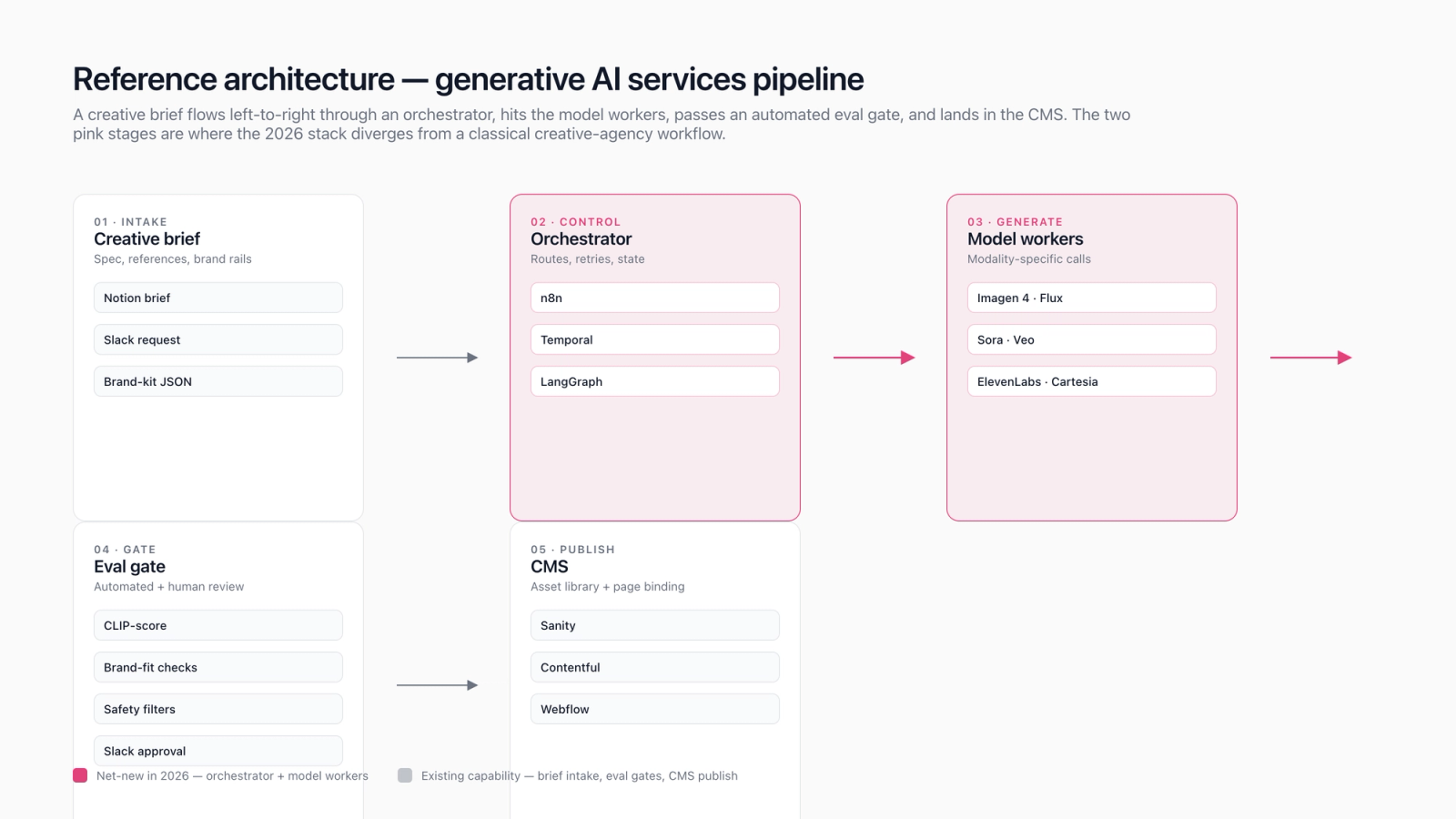
Shape one. Single-vendor hosted. The whole pipeline lives inside one platform: Vertex AI with Imagen 4 and Gemini, or AWS Bedrock with Titan and Claude, or Adobe Firefly with the Creative Cloud APIs. Brand control sits in prompt templates and reference images, with no custom checkpoint. Cost shape: roughly $0.03 to $0.08 per image render, $0.50 to $1.50 per 8-second video clip. It's the right pick when speed-to-first-asset matters more than brand fidelity. We recommend it in maybe 35% of engagements, usually B2B SaaS and early-stage commerce where brand systems are still loose.
Shape two. Routed multi-vendor. Fal and Replicate and Runware, or a custom Python router sits in front. The pipeline calls Imagen 4 for hero stills, Flux Pro 1.1 for fast iteration, Stable Diffusion 3.5 for stylised work, Runway Gen-3 for short video, ElevenLabs for voice. The router abstracts the model API so swapping vendors is a config change rather than a refactor. Brand control sits in prompt engineering plus reference-image conditioning plus CLIP-based similarity gating. Use this shape when the brand brief is varied enough that no single vendor wins all the work (a $0.04 Imagen render versus a $0.003 Flux Schnell render is a 13x cost delta on similar briefs), and when vendor risk is real. We pick this in maybe 45% of engagements. It's the modal answer.
Shape three. Self-hosted with custom checkpoints. Diffusers plus ComfyUI workers running SD 3.5 or Flux Dev on Modal or RunPod or Cloud Run. A versioned brand LoRA per model line. Brand control is in the checkpoint itself. Use this shape when brand identity is a strategic moat (luxury or fashion or regulated CPG), when generation volume crosses 50,000 assets a month and cost-per-image needs to land below 1 cent fully loaded, or when on-prem inference is a compliance requirement. It costs an MLOps engineer to operate but ages best on a 3-year horizon. We pick it in 20% of engagements; the deeper pattern lives in our piece on brand-locked generation with custom LoRA workflows.
Best generative ai services by modality (image and video and audio, text, 3D)
Ranking the best generative ai services on a single axis is a fool's errand. "Best" depends on whether you're shipping luxury product stills, a 6-shot brand film, a synthesised voiceover, or expansion copy for a press cycle. Below is the modality-by-modality view we'd hand a creative-ops lead today, with the price bands we see on invoices. Treat it as the working set, not a leaderboard.
| Modality | Top vendor picks (2026) | Routing pattern | Typical cost-per-render |
|---|---|---|---|
| Image: brand hero | Imagen 4, Flux Pro 1.1, Midjourney v6 | Imagen via Vertex; Flux via Fal or Replicate | $0.03–$0.08 per render |
| Image: fast iteration | Flux Schnell, Stable Diffusion 3.5, SDXL | Fal Flux Schnell endpoint; ComfyUI for SD3.5 | $0.003–$0.02 per render |
| Video: short brand clip | Sora, Veo 2, Runway Gen-3, Kling 1.5 | Runway API, Veo via Vertex, Sora via OpenAI | $0.50–$1.50 per 8-sec clip |
| Video: animation / VFX | Pika, Runway Gen-3, Kling | Pika web API; Runway API for keyframe control | $1.00–$3.00 per clip |
| Audio: voice | ElevenLabs and Cartesia plus OpenAI TTS | ElevenLabs API; Cartesia for low-latency | $0.05–$0.30 per minute |
| Audio: music | Suno and Udio and Stable Audio | Suno API for short cuts; Udio for variation | $0.10–$0.50 per track |
| Text: long-form copy | Claude Sonnet 4, GPT-4 Turbo, Gemini 2.0 | Anthropic / OpenAI / Vertex APIs directly | $0.003–$0.015 per 1K tokens out |
| 3D: product turntable | Stable Fast 3D, TripoSR, Meshy | Replicate hosts most; Meshy direct API | $0.10–$0.40 per mesh |
Three things to notice in the modality table. First, image and audio per-render costs have collapsed under one cent for fast iteration. The budget conversation is now about how many renders you need per approved asset. Second, video is still the expensive modality. Sora and Veo 2 cost 20 to 50x more per second than image generation; that's the line item agencies under-budget most often. Third, long-form copy (Claude Sonnet 4, GPT-4 Turbo, Gemini 2.0) is so cheap that the cost driver is human-review time, not inference. The procurement frame has to recentre on cost-per-approved-asset.
The modality we get asked about most is image generation for product and brand work. The 2026 default. Imagen 4 via Vertex AI for hero shots when photographic fidelity matters. Flux Pro 1.1 via Fal for stylised brand work where Imagen's aesthetic is too generic. SD 3.5 via ComfyUI or Diffusers when a brand-specific LoRA is in play. Midjourney v6 still wins on a narrow band of art-directed work, but its API surface is the weakest of the four. DALL-E 3 is operationally fine but prompt grammar is loosely constrained. The consistent answer for serious brand work is a routed pair rather than a single pick.
Generative ai services examples — what creative teams actually ship in 2026
The most useful way to internalise generative ai services examples is by deliverable shape, since that's also how creative-ops budgets get carved. Every example below is a workflow shape we've shipped or specced in the last 18 months; we've avoided naming brands to keep the framing typical-engagement-shape. Treat each row as a recipe.
| Deliverable | Workflow shape | Stack | Typical cost shape |
|---|---|---|---|
| Brand hero stills | Brief → Flux Pro generate → CLIP brand filter → Frame.io review | Fal + Flux Pro 1.1 + Postgres + Frame.io | ~$0.05 per render, ~$0.40 per approved asset |
| Social variant batch | One hero → 40 variants → auto-filter → Notion DAM | n8n + Flux Schnell via Fal + Pinecone + Notion | ~$0.003 per render, ~$0.05 per shipped variant |
| Short brand film (8s) | Script → boards → Runway Gen-3 shots → ElevenLabs voice → grade | Temporal + Runway + ElevenLabs + Frame.io | ~$1.20 per draft clip, ~$8 per approved 8s spot |
| Press-release draft pack | Brief → Claude expand → fact-check → Notion review queue | Claude Sonnet 4 + Pinecone + Notion | ~$0.02 per draft, ~$0.10 per shipped release |
| Product turntable (3D) | Reference photo → Stable Fast 3D → mesh review → AR export | Replicate + Stable Fast 3D + Meshy + S3 | ~$0.20 per mesh, ~$1.20 per shipped turntable |
| Voiceover for explainer | Script → ElevenLabs voice clone → noise gate → Frame.io | ElevenLabs + ffmpeg + Frame.io | ~$0.10 per minute, ~$0.30 per shipped take |
| Music bed for ad cut | Brief → Suno generate → Stable Audio variation → cut to length | Suno + Stable Audio + Cartesia + ffmpeg | ~$0.25 per track, ~$1.50 per shipped bed |
| Personalised email creative | CRM segment → Flux + GPT-4 copy → Customer.io | n8n + Flux Schnell + GPT-4 Turbo + Customer.io | ~$0.008 per send variant |
Two things to notice in the deliverables table. First, the gap between cost-per-render and cost-per-approved-asset is huge. A $0.003 Flux Schnell render hides a 1-in-20 approval rate on unstructured creative briefs; the fully-loaded cost lands closer to $0.06. Still a deal compared to $250 per stock-photography license. Second, voice and music are the modalities where vendor lock-in costs the most operationally. ElevenLabs voice clones don't port to Cartesia, and Suno tracks can't be regenerated identically on Udio. Plan for that early.
The deliverable we get asked about most is the social-variant batch: one hero asset blown out to 40 sized variants for paid social. The 2026 default: a single Flux Pro 1.1 hero fed into a Flux Schnell variant pass via Fal (with seed locking and IP-Adapter for brand consistency), CLIP-filtered against a brand-reference set, assembled per channel by n8n into Notion or a DAM. Cost lands around 5 cents per shipped variant fully loaded. Teams that skip the CLIP gate end up with 15 to 20% of variants drifting off-brand (2026-Q1 eval) and needing designer cleanup, which kills the math. The gate is a 30-minute build and the highest-ROI step in the whole pipeline.
The generative ai services platform landscape, vendor-by-vendor
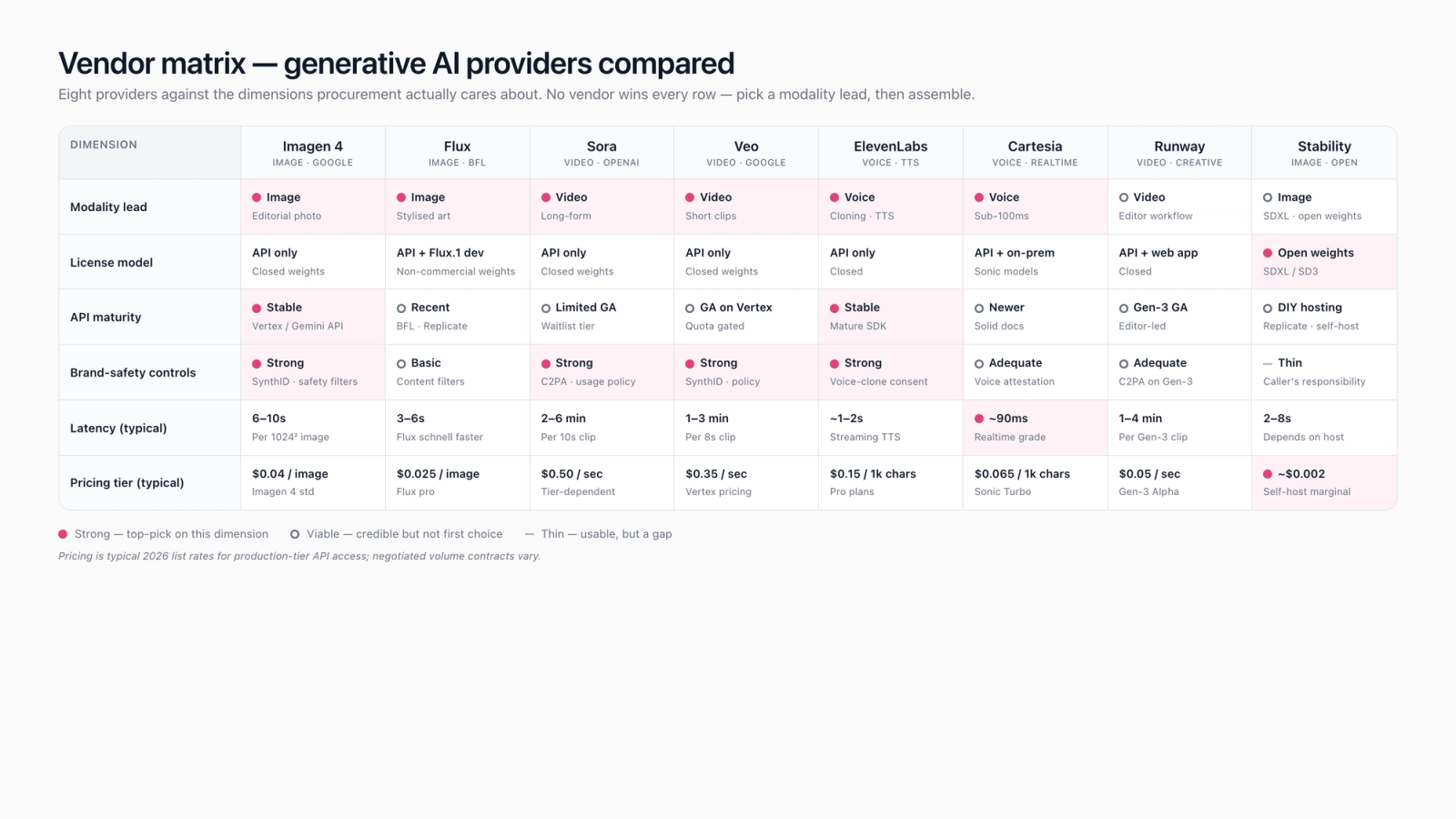
The generative ai services vendor landscape in 2026 has roughly twelve names that matter for a mid-market creative-ops buyer across image plus video, audio and text. We score the image-modality pool on five axes that match the procurement spreadsheet we actually use: brand-control depth, prompt fidelity, per-render cost, latency at scale, and the breadth of the surrounding ecosystem (LoRA training, ControlNet, IP-Adapter, hosted access). The matrix below is what we'd put in front of a creative steering committee tomorrow. Video and audio shops are handled in the follow-on note.
| Vendor | Brand control | Prompt fidelity | Cost shape | Latency | Ecosystem |
|---|---|---|---|---|---|
| Imagen 4 (Vertex AI) | 6/10 · reference image, no LoRA | 9/10 · strongest photoreal | 7/10 · $0.04 per render | 8/10 · ~3s at p50 | 7/10 · Google ecosystem, Cloud Run |
| Flux Pro 1.1 (BFL via Fal) | 8/10 · LoRA on Flux Dev viable | 9/10 · sharp typography, strong prompts | 8/10 · $0.04–$0.05 per render | 9/10 · sub-2s on Fal serverless | 9/10 · Diffusers and ComfyUI plus Replicate and Fal |
| Stable Diffusion 3.5 Large | 10/10 · open weights, full LoRA | 8/10 · strong with proper sampler | 9/10 · ~$0.003 on ComfyUI self-host | 7/10 · depends on your GPU pool | 10/10 · biggest open ecosystem |
| Midjourney v6 | 5/10 · style refs, no checkpoint access | 9/10 · best aesthetic out-of-box | 6/10 · $0.04–$0.08 effective | 6/10 · queue-dependent | 5/10 · partner APIs only |
| DALL-E 3 (OpenAI) | 4/10 · natural-language only | 7/10 · strong on conceptual | 5/10 · $0.04–$0.08 per HD | 7/10 · ~5s typical | 7/10 · OpenAI SDK integration |
| Adobe Firefly (Creative Cloud) | 7/10 · brand kits, asset library | 7/10 · safe defaults, less peak | 5/10 · bundled into CC plans | 8/10 · fast in-app | 8/10 · Photoshop, Illustrator native |
| Stable Diffusion XL (legacy) | 9/10 · mature LoRA scene | 6/10 · losing ground to SD3.5 / Flux | 10/10 · cheapest open-weight to run | 8/10 · fastest at high batch | 9/10 · largest checkpoint library |
| Ideogram 2.0 | 5/10 · limited brand-control depth | 8/10 · strongest text-in-image | 7/10 · $0.05 per render | 7/10 · ~4s typical | 6/10 · API maturing |
Reading the matrix as a buyer. Imagen 4 wins photoreal fidelity, loses on LoRA brand control. Flux Pro 1.1 wins prompt fidelity and ecosystem, loses on per-render cost. Stable Diffusion 3.5 wins brand control and cost, loses on out-of-box aesthetic without a tuned checkpoint. Midjourney wins aesthetic, loses on API surface. The honest answer for most mid-market creative teams is a pair: Flux Pro 1.1 for art-directed brand work plus Imagen 4 (or Stable Diffusion 3.5 with a LoRA) for the long-tail variant work, routed through Fal. Single-vendor pitches paper over a real gap. Our deeper companion piece on the technical trade between the foundation architectures runs at depth.
On video, the picture is messier and changing faster. Sora is the strongest at narrative continuity but API access is partner-gated and pricing has moved twice in 6 months. Veo 2 is the best-integrated path for teams already on Google Cloud. Runway Gen-3 is the most production-ready API for short brand work. We pair Runway plus Veo for most agency stacks and reach for Sora only when the brief needs a 20-second-plus continuous narrative. On audio, ElevenLabs is the strongest voice vendor but Cartesia is closing the latency gap fast (live narration, dynamic ad insertion). Suno owns short-form music; for longer scoring we'd still bring in a real composer. Our note on the state of video model picks in 2026 walks the video shortlist in more depth.
Generative ai services implementation: a working pipeline in code
A concrete generative ai services implementation makes the architecture choices land harder than any matrix. Below are two snippets we'd ship: a routed Replicate call with Flux Pro 1.1 primary and SD 3.5 fallback, and a self-hosted Diffusers worker that loads a brand LoRA. Both encode the same workflow (brief in, image out, CLIP brand-filter, write to Postgres) so you can read them as a paired comparison.
# Routed generative ai services call: try Flux Pro 1.1 first, fall back to SD 3.5.
# Hosted on Cloud Run, fronted by FastAPI, persisted to Postgres.
import os
import requests
import replicate
import psycopg2
from open_clip import create_model_and_transforms, tokenize
import torch
from PIL import Image
from io import BytesIO

CLIP_MODEL, _, CLIP_PRE = create_model_and_transforms("ViT-L-14", pretrained="openai")
BRAND_REF_EMBED = torch.load("/data/brand_ref_embed.pt")  # pre-computed CLIP embed for brand reference set

def generate(prompt: str, brand_token: str = "") -> dict:
    full_prompt = f"{prompt}, {brand_token}" if brand_token else prompt
    try:
        # Primary path: Flux Pro 1.1 via Replicate (~$0.04/render)
        out = replicate.run(
            "black-forest-labs/flux-1.1-pro",
            input={"prompt": full_prompt, "aspect_ratio": "1:1", "output_format": "png"},
        )
        img_url = out[0] if isinstance(out, list) else out
        model_used = "flux-1.1-pro"
    except Exception:
        # Fallback path: SD 3.5 Large (~$0.003/render via ComfyUI; via Replicate ~$0.035)
        out = replicate.run(
            "stability-ai/stable-diffusion-3.5-large",
            input={"prompt": full_prompt, "aspect_ratio": "1:1"},
        )
        img_url = out[0] if isinstance(out, list) else out
        model_used = "stable-diffusion-3.5-large"

    img = Image.open(BytesIO(requests.get(img_url, timeout=30).content)).convert("RGB")
    # CLIP brand-similarity gate: cosine vs brand reference embed
    with torch.no_grad():
        embed = CLIP_MODEL.encode_image(CLIP_PRE(img).unsqueeze(0))
        embed = embed / embed.norm(dim=-1, keepdim=True)
        sim = float((embed @ BRAND_REF_EMBED.T).max())

    keep = sim >= 0.78
    conn = psycopg2.connect(os.environ["DSN"])
    with conn.cursor() as cur:
        cur.execute(
            "INSERT INTO generations (prompt, model, url, brand_sim, kept) VALUES (%s,%s,%s,%s,%s) RETURNING id",
            (full_prompt, model_used, img_url, sim, keep),
        )
        gen_id = cur.fetchone()[0]
    conn.commit()
return {"id": gen_id, "url": img_url, "brand_sim": sim, "kept": keep, "model": model_used}# Self-hosted generative ai services worker: SD 3.5 Large + brand LoRA on Modal.
# Volume-mounted weights, GPU-backed, callable as a Modal endpoint.
import modal
import torch
from diffusers import StableDiffusion3Pipeline
app = modal.App("brand-image-worker")
image = (
modal.Image.debian_slim(python_version="3.11")
.pip_install("diffusers==0.31.0", "transformers", "accelerate", "peft", "sentencepiece")
)
vol = modal.Volume.from_name("brand-weights", create_if_missing=True)
@app.cls(image=image, gpu="A100-40GB", volumes={"/weights": vol}, scaledown_window=120)
class BrandWorker:
@modal.enter()
def load(self):
self.pipe = StableDiffusion3Pipeline.from_pretrained(
"stabilityai/stable-diffusion-3.5-large",
torch_dtype=torch.bfloat16,
).to("cuda")
# Brand LoRA was trained on roughly 80 brand reference images; ~30 min on A100.
self.pipe.load_lora_weights("/weights/brand_v3.safetensors", adapter_name="brand")
self.pipe.set_adapters(["brand"], adapter_weights=[0.85])
@modal.method()
def generate(self, prompt: str, seed: int = 0):
gen = torch.Generator("cuda").manual_seed(seed)
# 28 steps is the SD3.5 sweet spot; LoRA active at 0.85 strength.
img = self.pipe(
prompt=prompt,
num_inference_steps=28,
guidance_scale=4.5,
height=1024,
width=1024,
generator=gen,
).images[0]
# Cost shape on Modal A100-40GB: ~$0.0008/render at this config.
return imgThree implementation gotchas we hit repeatedly. First, the brand-similarity gate is worth its weight in saved designer hours. A 30-line CLIP cosine check against a pre-computed brand reference embed catches 60 to 80% of off-brand renders before a human sees them. The gate threshold (we start at 0.75 cosine and tune) is the most-tweaked knob across a 90-day engagement. Second, retries cost real money on hosted APIs. A Replicate call that retries Flux Pro three times because the upstream had a 502 has just billed you 3x. Cap retries at 2 on generation activities. Third, observability has to be designed in at day one. Every generation lands in Postgres with prompt, seed, model, brand-sim score. Skip it and you're flying blind into the second campaign cycle.
On the integration layer, two pieces are worth budgeting up front. Pinecone or pgvector for the brand-asset retrieval index. Pure-generation pipelines without retrieval drift off-brand within six weeks of launch. And a thin Python adapter (LangChain for text; a 250-line module for image) that abstracts model vendors so you can swap Flux Pro for Imagen 4 without rewriting the calling code. Vendor risk on the model side is the second-largest risk after brand-control loss. We wire this kind of stack regularly through our AI integration services.
The evaluation framework for generative ai services against a creative brief
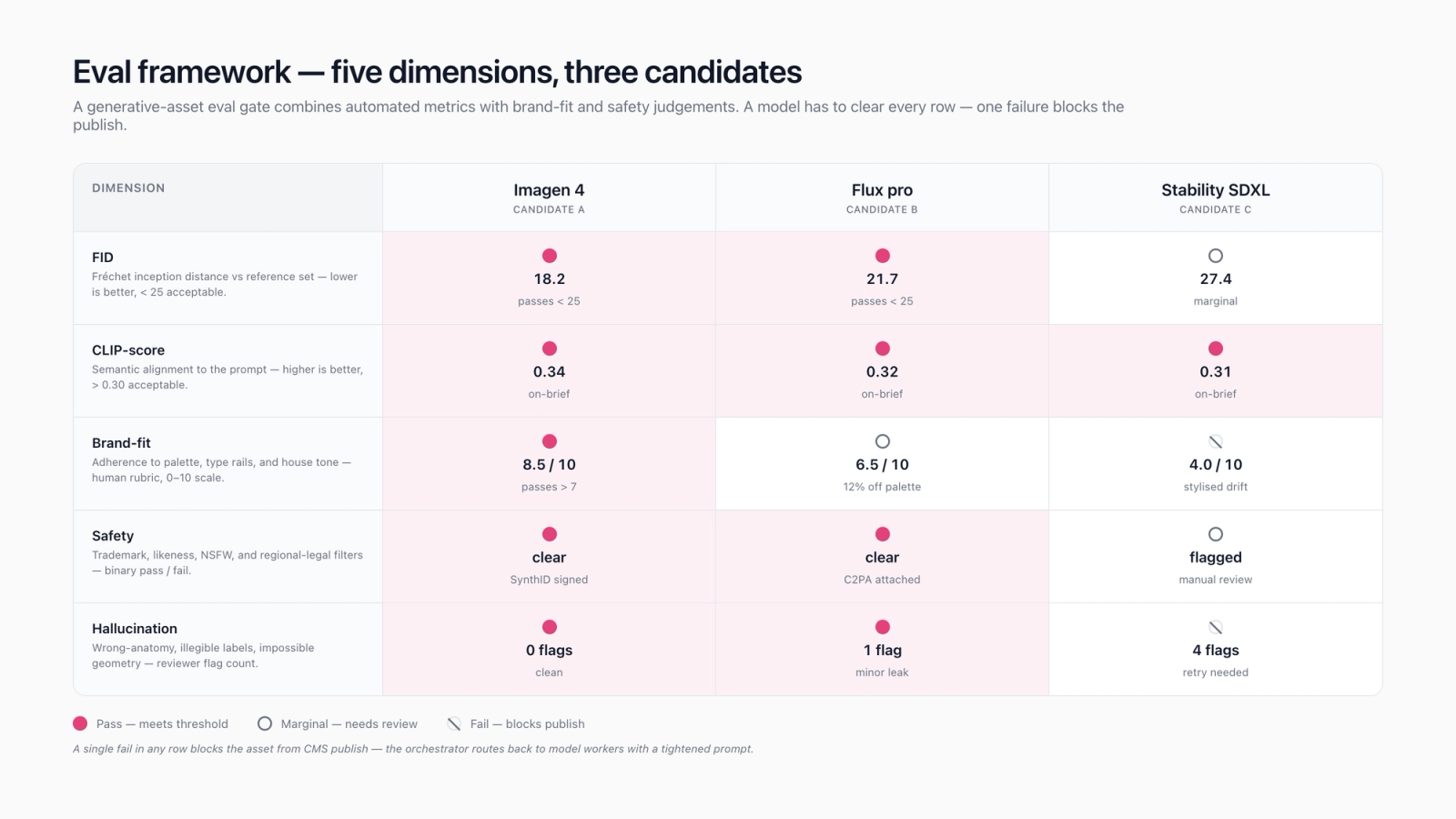
Most generative ai services RFPs we see are scored on the wrong axes: model leaderboard rank, demo polish, raw image quality on cherry-picked prompts. Here's the seven-axis framework we'd put on the procurement spreadsheet instead. Each row scores 0 to 3 against a specific brand brief. The matrix below is what we hand a creative steering committee at vendor-shortlist time.
| Evaluation axis | Why it matters | How to score |
|---|---|---|
| Brand-control depth | Without LoRA or reference-image conditioning, brand-locked work drifts within 4 weeks | LoRA training + reference-image API + IP-Adapter support = 3; prompt-only = 0 |
| Per-approved-asset unit cost | Cost-per-render is vanity; cost-per-shippable-asset is the metric | Model 10k, 100k briefs/year; does the math stay under your asset-license benchmark? 3 if yes |
| Modality coverage | Image and video and audio, text — single-vendor coverage is rare; routing is the default | Need 3+ modalities? Pick a router or commit to multi-vendor. Score 3 if multi-vendor-ready |
| Vendor / model portability | Sora pricing moved twice in 6 months; lock-in is real and expensive | Can you swap the underlying model in under 1 day? If yes, 3. If never, 0 |
| Self-host / on-prem posture | Regulated industries (luxury, regulated CPG, defence) can't ship brand IP through a public cloud model | Open weights + Docker + private GPU pool = 3; cloud-only with no DPA = 0 |
| Safety + IP provenance | Content moderation plus watermarking plus training-data provenance — legal-bar items for serious brands | Vendor publishes provenance + supports SynthID-style marking = 3; opaque = 0 |
| Time to first approved asset | If pilot takes more than 6 weeks to ship one approved hero, momentum dies | Score against a 4-week pilot brief: shipped + brand-approved = 3 |
The vendor that wins on this scorecard is usually not the vendor that wins on the marketing pages. Imagen 4 scores high on prompt fidelity, low on brand-control depth. Stable Diffusion 3.5 self-hosted scores high on portability, low on time-to-first-asset. Flux Pro 1.1 scores high across most axes but loses on the open-weight / self-host axis. Pick the pair that closes the gaps for your brief. Our companion piece on the legal and provenance posture across model vendors walks the safety axis in more depth. Worth reading before a regulated buyer signs.
Build vs buy vs assemble: where each delivery model earns its keep
The build-vs-buy conversation on generative ai services used to be binary: license Adobe Firefly and Canva Magic Studio and call it a day, or spin up a research team. In 2026 it's three options, and we use all three across engagements.
Option one. Buy a managed creative-suite platform end-to-front. Adobe Firefly plus Creative Cloud for everything, or Canva Magic Studio for the marketing-ops side. Vendor owns brand kits, asset library, hosting, model billing. Right for marketing teams without engineering capacity, wrong for anything that needs a custom brand checkpoint or volumes past 100K shippable assets a year where per-seat pricing eats the budget. The right pick maybe 25% of the time.
Option two. Build the routing layer yourself on Fal or Replicate or a custom Python adapter, integrate Imagen 4 and Flux Pro 1.1 and Runway Gen-3 directly. Right for creative-ops shops with at least one engineer, right at volumes where managed-platform pricing crosses into running the calls yourself. We pick this in 50% of engagements, almost always when the brand needs to ship across image plus video plus audio in the same campaign cycle.
Option three. Assemble. The call most creative-ops teams underweight. Pair a routed multi-vendor layer for the bulk of the work with a self-hosted Diffusers plus LoRA worker for brand-locked hero work where checkpoint control is the moat. The routed layer handles 80% of briefs where speed matters more than the last 10% of brand fidelity; the self-hosted worker handles the hero work where it doesn't. We recommend it roughly a quarter of the time. The pattern ages best because either half can be swapped without touching the other. The deeper trade-offs live in our engagement note on generative AI development services.
ROI and TCO modelling: the unit economics most agency decks skip
Procurement decks for generative ai services overwhelmingly anchor on cost-per-render math, and that doesn't survive a CFO review. The right unit is cost-per-approved-asset, modelled against the current cost-per-asset baseline (stock-photography license or photoshoot frame or in-house designer hour). If a stock license is $250 per image and a Flux Pro 1.1 pipeline runs at $0.40 per approved asset fully loaded, the saving per asset is roughly 600x. Multiply by annual volume, subtract build cost, and you've got a payback curve procurement can sign.
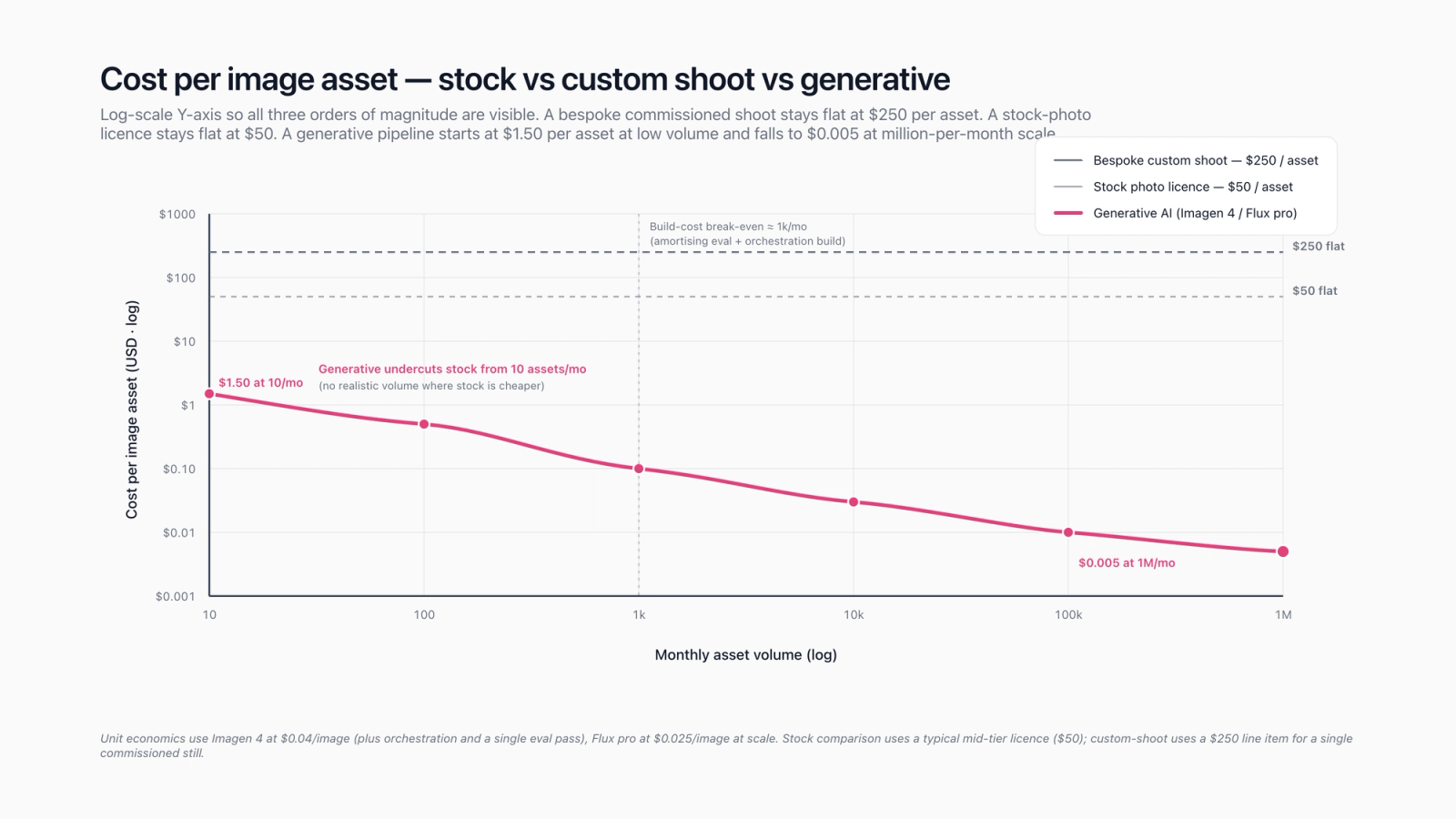
The model needs four inputs: shippable assets per month (V), cost-per-asset baseline (Cb), cost-per-approved-asset after generative (Ca), and build plus ongoing cost (B). Monthly saving is V × (Cb − Ca). Payback months = B ÷ monthly-saving. For a 500-asset-per-month e-commerce catalogue at Cb = $250 and Ca = $0.40 with a mid-scale build, payback lands inside the first month. For a 200-asset-per-month brand-locked campaign at Cb = $1,500 and Ca = $2.50 with a larger-scale build, payback runs 2 to 3 weeks of ongoing volume. CFOs respect simple models. What they won't respect is "10x faster than a photoshoot"; that doesn't compose into a P&L.
Three line items procurement decks routinely under-budget. First, reviewer time. A pipeline that generates 40 variants per brief still needs a brand reviewer to approve 4 to 8 of them: 5 to 15 minutes of designer time per brief. At agency rates of $80 to $120 an hour, reviewer cost can outweigh inference cost on small-batch work. Second, brand-LoRA refresh cadence. A LoRA trained on the current brand-asset library drifts roughly every 6 to 9 months; budget a quarterly retrain at 4 hours of A100 time plus 2 days of engineer work. Third, model price drift. The line to forecast is volume rather than unit cost. A successful pipeline tends to drive 2 to 4x the volume the spec assumed once creative teams trust the output.
On TCO over a 24-month horizon, reviewer time dominates, not inference. A 500-approved-asset-per-month operation on Flux Pro 1.1 at $0.04 per render and 8 renders per approved asset lands at roughly $160 per month of inference. Rounding error against most creative budgets. The reviewer cost on the same volume runs $4,000 to $7,500 per month. The higher-leverage lever in 2026 is the brand-similarity gate threshold. Every 0.02 you tighten the gate cuts reviewer load by roughly 10 to 15% on typical briefs. The inference invoice isn't where the budget lives anymore.
The generative ai services guide: an 8-step build checklist for creative ops
Use this generative ai services guide as a creative-ops kickoff checklist. We run a version in every discovery workshop, and the eight steps cover 90% of the decisions that determine whether a pilot ships on time. Step ordering matters. Skipping ahead is the most common failure mode, particularly on the brand-similarity gate (step six), which teams try to defer and almost always regret by week four.
Step one. Pick one deliverable shape with named volume; don't automate an entire brand library in a single pilot. Step two. Set a cost-per-approved-asset ceiling before you pick a vendor; if the ceiling is $0.50, that rules out Sora on long-form video. Step three. Pick the architecture shape (hardest reversal later). Step four. Pick the model pair (primary plus fallback); Flux Pro 1.1 with Imagen 4 fallback is our default image pair. Step five. Wire retrieval against your brand asset library. Step six. Build the brand-similarity gate before you ship: CLIP cosine against a reference embed, threshold tuned on 200 known-good and 200 known-bad renders. Step seven. Ship the review queue (Frame.io for video and image; Notion for copy). Step eight. Instrument cost from day one in Postgres or BigQuery. Without that, the second-campaign budget conversation is unwinnable.
The brand-similarity gate is a 30-line CLIP cosine check that catches roughly 60 to 80 percent of off-brand renders before a human reviewer sees them. It's the single highest-ROI step in a generative ai services pipeline.
We cross-walk kickoffs with our AI consulting services when the buyer hasn't yet decided whether generative ai services are the right wedge versus a broader LLM-and-RAG investment. If the brief is text-heavy rather than visual-heavy, the conversation usually pivots to a LLM development services before we re-enter the creative-ops scoping. The two practices share the same observability and routing primitives, and the eight-step checklist above applies (with modality substitutions) to both.
FAQ on generative ai services, in the buyer's vocabulary
What are generative ai services in plain language?
A generative ai services stack is durable workflow software (n8n or Temporal or a custom Python router) plus a foundation-model call (Imagen 4, Flux Pro 1.1, Stable Diffusion 3.5, Sora, ElevenLabs, Claude Sonnet 4) plus a brand-asset retrieval layer (Pinecone, Postgres pgvector) plus a review queue (Frame.io or Notion). Together they replace a multi-step manual creative process like hero generation, social variant blow-out, voiceover, copy expansion. The 2026 default stack is two or three model vendors routed behind a thin adapter, not a single platform.
What's the best generative ai services platform for a brand-locked workflow?
For brand-locked work where checkpoint control matters, the strongest path is Stable Diffusion 3.5 Large self-hosted on Modal or RunPod with a brand-trained LoRA, fronted by a thin REST API. For brand-aware work where reference-image conditioning is enough, Flux Pro 1.1 via Fal or Replicate with IP-Adapter wins on cost-quality balance. Imagen 4 wins photoreal still life and product hero work when the brand can tolerate the Imagen aesthetic baseline. We rarely recommend a single-vendor pick for serious brand work. A routed pair almost always closes more gaps than any one model alone.
How is this different from running Midjourney by hand?
Midjourney v6 is a strong generative model but a hand-run Midjourney workflow isn't a service. No orchestration, no brand-asset retrieval, no cost accounting, no review queue, no portability if the model drifts. A generative ai services pipeline wraps a model call (Flux Pro 1.1, Imagen 4, SD 3.5, Sora, ElevenLabs) inside durable infrastructure you can audit and swap and scale. Per-asset cost tends to be 5 to 20x cheaper at volume. Hand-run Midjourney still earns its fee for one-off art-directed work.
What's a realistic timeline for the first workflow live?
8 to 12 weeks from kickoff to a production-ready first pipeline is the typical engagement shape: discovery and brand-asset inventory (2 weeks), architecture and vendor pair selection (2 weeks), build and integration including the brand-similarity gate (3 to 5 weeks), review-queue and observability hardening (1 to 2 weeks). Anyone pitching a 4-week production pipeline is either skipping the gate or skipping integration testing; both come back to bite inside the first campaign cycle, usually when an off-brand variant lands in front of a CMO.
How much does a generative ai services build cost?
For a single mid-market creative workflow at the architecture shapes covered above, build cost lands in a small-to-large build range depending on modality coverage and whether brand control needs a custom LoRA. Ongoing cost is dominated by reviewer time on most projects ($4,000 to $8,000 per month at mid volumes) plus inference ($200 to $1,500 per month depending on modality mix) plus the routing platform fee (Fal and Replicate are pay-as-you-go; Modal billed per GPU-second).
Can generative ai services protect brand IP and avoid training-data risk?
Yes, with the right stack. Use open-weight models on a self-host path (Stable Diffusion 3.5 or Flux Dev on Modal or RunPod) when training-data provenance is a legal-bar concern; use enterprise vendors with signed DPAs and SynthID-style marking (Imagen 4 on Vertex AI, Veo 2) when hosted inference is acceptable; avoid free-tier consumer APIs for any commercially-shipped asset. Encrypt brand reference imagery at rest. The legal posture varies by vendor and jurisdiction; we run a separate review for every regulated buyer.
Do I need LangChain or ComfyUI or neither?
Different jobs entirely. LangChain is a model-adapter library: useful for swapping GPT-4 for Claude in the text-modality side without rewriting code, less useful on the image side where Diffusers is the lingua franca. ComfyUI is a node-based pipeline editor for image and video generation: useful when designers want to compose Stable Diffusion or Flux pipelines visually, less useful when the pipeline runs server-side from a Python worker. Neither is required for routed multi-vendor stacks via Fal or Replicate. We ship plenty of pipelines that talk to Diffusers directly without any wrapper. The framework debate matters less than the architecture choice and the brand-control posture.
Specifying a generative ai services build for 2026?
We help creative-ops and engineering leads pick an architecture, score the vendor matrix across image plus video, audio and text. Ship the first production pipeline in weeks rather than quarters.