Customer service chatbot: a 2026 buyer's guide
A 2026 buyer's guide to customer service chatbots — RAG over your docs, eval gates on deflection, and what the LLM tier actually costs in production.


A customer service chatbot in 2026 isn't the intent-classifier widget you bought in 2019. It's a retrieval-augmented agent, plumbed into Zendesk or Intercom or Salesforce Service Cloud, that reads your knowledge base, drafts a reply, and either ships it to the customer or hands the conversation to a human agent with the right context attached. The vendor brochures still call it a customer service chatbot — but the architecture beneath has been rebuilt twice in three years, and the buying decision in 2026 is a different decision from the one most support teams made the last time they shopped.
Over the past 18 months we've reviewed customer service chatbot briefs across mid-market SaaS, regulated fintech, and high-volume e-commerce — this is the buyer's guide that ended up most useful in those conversations. Below is the doc we wish existed when those briefs landed: a vendor matrix without the affiliate bias, a working RAG architecture you can copy, the cost-per-resolved-contact math your CFO will ask for, and a 90-day rollout checklist that survives procurement. If you're scoping a customer service chatbot for next quarter, this is the doc to read before the demos start.
Customer service chatbot in one paragraph, and what changed in 2026
A customer service chatbot is the automated layer that reads an inbound support message, decides whether it can answer or must escalate, and either ships a reply or hands the conversation to a human agent. That's the same definition you'd have written in 2019. What's changed is the engine underneath. The 2019 chatbot used intent classification on a fixed taxonomy — you told it about thirty topics, it routed accordingly, and anything off-script failed silently. The 2026 customer service chatbot uses a language model (Claude Sonnet 4.6, GPT-5 mini, Gemini 3.0 Flash) plus retrieval over your knowledge base, which means it doesn't need the taxonomy at all. It reads the customer's actual question, fetches the three most relevant help-center articles, and drafts an answer grounded in your own content. That single architectural shift is what makes the buying decision genuinely different this time around.
There's a second shift that's easier to miss. Vendors who built their customer service chatbot stacks before 2023 (Zendesk Answer Bot, Salesforce Einstein Bots, IBM Watsonx Assistant) have spent two years bolting LLMs onto intent engines. Vendors who started after 2023 (Intercom Fin, Ada's newer product, Decagon, Forethought) built LLM-first from day one. They're not the same product anymore. The first group still wins on deep ticketing integration; the second group wins on out-of-the-box answer quality. Knowing which side a vendor sits on is the single biggest signal you'll use during a customer service chatbot RFP this year.
The 2026 customer service chatbot decision isn't 'which platform' — it's 'which control plane, which LLM layer, and how do they decouple'.
What a customer service chatbot actually does today, in the buyer's language
Support leaders don't buy a customer service chatbot to win an AI-strategy headline. They buy it to move four numbers: deflection rate (the share of inbound contacts the bot closes without a human), average handle time (AHT, the minutes a human agent spends per ticket), escalation quality (whether the bot's handoff leaves the agent better or worse off than a cold ticket), and customer satisfaction (CSAT or its sibling, a transactional NPS). Every customer service chatbot demo you'll sit through this year wants to talk about deflection. Most won't talk about escalation quality at all, which is exactly where most rollouts quietly fail. There's a fifth lever the strongest rollouts pull on as well: AI automation agency — the rules and workflows that decide which intents the bot is allowed to touch, which queue receives an escalation, and which tickets bypass the bot entirely because the customer signal (VIP tier, sentiment, regulated topic) makes a bot reply the wrong move. Treat that routing layer as part of the chatbot brief, not a side-project for ops, and the bot's deflection number tends to land higher and cleaner.
Here's the inversion that matters. A customer service chatbot that deflects 40% of tickets but hands the other 60% to agents with a confused transcript actually raises your fully loaded cost-per-resolved-contact, because agents now repair the bot's mess on top of solving the original issue. It's the pattern we flag on every customer service chatbot brief: deflection looks great on the dashboard, AHT on escalated tickets climbs by 20–30%, CSAT on those tickets craters, and the support director gets called into a QBR she didn't expect. Work the math on a typical mid-market shape — 40k tickets a month, $10 fully-loaded human cost, $0.15 bot cost. A bot that deflects 40% cleanly trims monthly support cost from a high-six-figure annual run-rate down to a markedly smaller annual cost. The same bot deflecting 40% but adding 25% to escalated AHT pushes the residual 60% cost to about a defined-budget engagement, and now you've saved a fraction of what the gross-deflection slide claimed. The right scoreboard for a customer service chatbot is cost-per-resolved-contact at a 4+ CSAT threshold — not deflection alone, and not deflection net of nothing.
Customer service chatbot architecture: the three reference shapes we ship
When a brief lands, we sketch one of three customer service chatbot architectures on the call before we quote. Picking the right shape early saves a quarter of re-architecture later. We'll name them by their control-plane style.
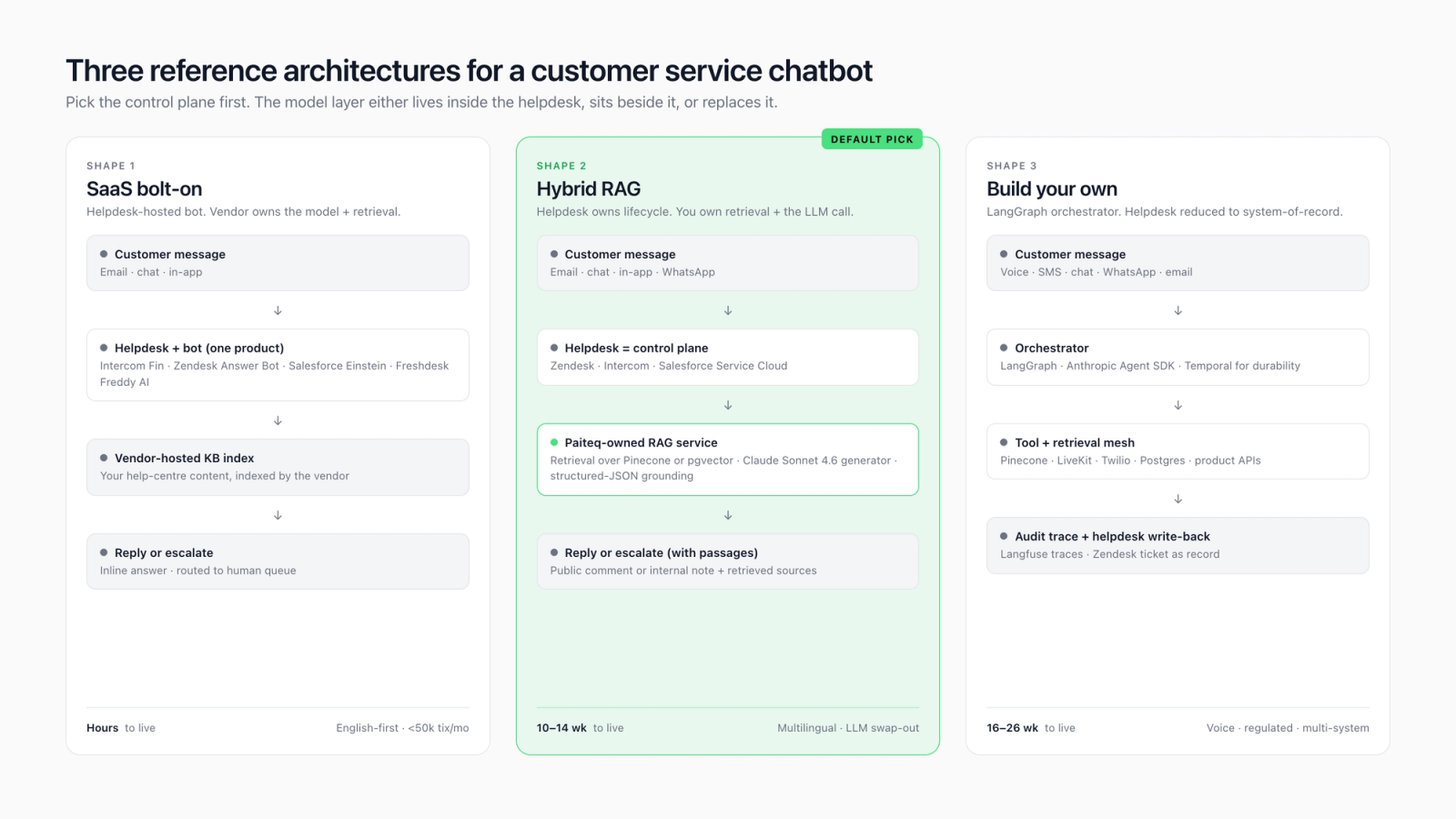
Shape one, the SaaS bolt-on, turns on a customer service chatbot module inside the helpdesk you already pay for. Intercom Fin and Zendesk Answer Bot are the canonical examples; Salesforce Einstein Bots and Freshdesk's Freddy AI sit in the same bucket. Setup is hours, not weeks. The vendor hosts the model, the retrieval, the orchestration. You pay per-resolution or per-seat. It's the right pick for English-only, low-to-medium volume, knowledge-base-rich orgs where the helpdesk is already entrenched.
Shape two, hybrid RAG, keeps your helpdesk as the front door (Zendesk, Intercom, Salesforce Service Cloud) but routes the model call out to your own RAG development services. The helpdesk handles ticket lifecycle and routing; a small service you control runs the retrieval against Pinecone or pgvector and calls Claude Sonnet 4.6 or GPT-5 mini for generation. This is what we ship for teams that have a multilingual KB, a non-standard data source (a legacy product catalog, a regulated compliance corpus), or a privacy requirement that won't allow the SaaS vendor to host the model. It's also what teams migrate to when the SaaS bolt-on hits a ceiling on answer quality.
Shape three, build your own, replaces the helpdesk's bot layer entirely with a LangGraph or Anthropic Agent SDK orchestration over your own infrastructure. The helpdesk is reduced to a system-of-record. We don't recommend this shape often; it's reserved for teams with a hard reason to own the whole stack (deep voice integration via LiveKit or Twilio, a regulated audit requirement, or a multi-product router where the bot needs to traverse five backend systems mid-conversation). Engineering cost is real, but so is the lock-in escape.
| Where it wins | Where it breaks | |
|---|---|---|
| Shape 1 — SaaS bolt-on (Intercom Fin, Zendesk Answer Bot) | Live in hours; vendor owns the model and retrieval; one bill | Ceiling on answer quality; non-English support thin; no swap-out path for the LLM |
| Shape 2 — Hybrid RAG (Zendesk + own retrieval + Claude) | Multilingual; custom data sources; LLM swap is a config change | Two systems to operate; you own the eval pipeline |
| Shape 3 — Build your own (LangGraph + Pinecone + Twilio) | Voice + multi-system + audit-grade traces; full control | Engineering investment is the size of a real product; payback past 12 months |
Customer service chatbot examples by industry, and why the shape changes
The reference architecture above isn't industry-blind. The customer service chatbot examples we end up shipping look different by vertical because the data, the regulation, and the channel mix change everything. Three forces do most of the work. First, the knowledge base. A SaaS team owns a help center; a fintech team owns a compliance corpus that's been red-pen-reviewed by legal; a healthcare team owns clinical FAQs that can't be paraphrased loosely. The bot needs different grounding rules in each case, which means a different retrieval layer and a different generation prompt. Second, the channel mix. Chat-first teams can ride a SaaS bolt-on; voice-first or WhatsApp-heavy teams almost always end up in Shape 3 because no SaaS bolt-on covers the channel stack from voice to chat to ticket. Third, the regulation. HIPAA, PCI-DSS, SOC 2 Type II, GDPR Article 22 — each one constrains where the model runs, what it logs, and how the audit trail is preserved. A chatbot that's compliant for SaaS isn't automatically compliant for fintech, and the vendor's marketing site is the worst place to confirm that. Here's what we typically see across the five industries we get the most briefs from.
| Mid-market SaaS | Email + in-app chat | Help-center articles + internal runbooks | Shape 2 (hybrid RAG) on Zendesk + Claude Sonnet 4.6 | Onboarding troubleshooting + billing self-serve |
| E-commerce | Chat + email + WhatsApp | Product catalog + order DB + shipping API | Shape 2 with custom tool calls (order lookup, refund draft) | Order-status and returns automation |
| Fintech (regulated) | Secure messaging + email | Compliance corpus + product T&Cs + KYC playbook | Shape 3 (build) on LangGraph with audit trace | Account servicing with regulatory guard-rails |
| Healthcare (HIPAA) | Patient portal + SMS | Clinical FAQ + appointment system + insurance routing | Shape 3 with PHI redaction + Langfuse for audit | Appointment scheduling and triage routing |
| Logistics + delivery | Voice + chat + WhatsApp | Tracking API + driver dispatch + claims docs | Shape 3 with LiveKit voice + Twilio fallback | Tracking, ETA updates, claim intake |
Two patterns hold across all five. First, the knowledge base shape, not the volume, determines the architecture. A well-structured help center with 200 articles is easier to ship than a sprawling 2,000-article archive with no metadata. Second, the channel mix dictates the build. A chat-only deployment lands inside Shape 1 or Shape 2 most of the time; the moment voice, SMS, or WhatsApp join the mix, you're in Shape 3 territory or you're stitching together two SaaS vendors. Pick the architecture for the channels you'll have in 18 months, not the channels you have today.
The customer service chatbot vendor landscape, vendor-by-vendor
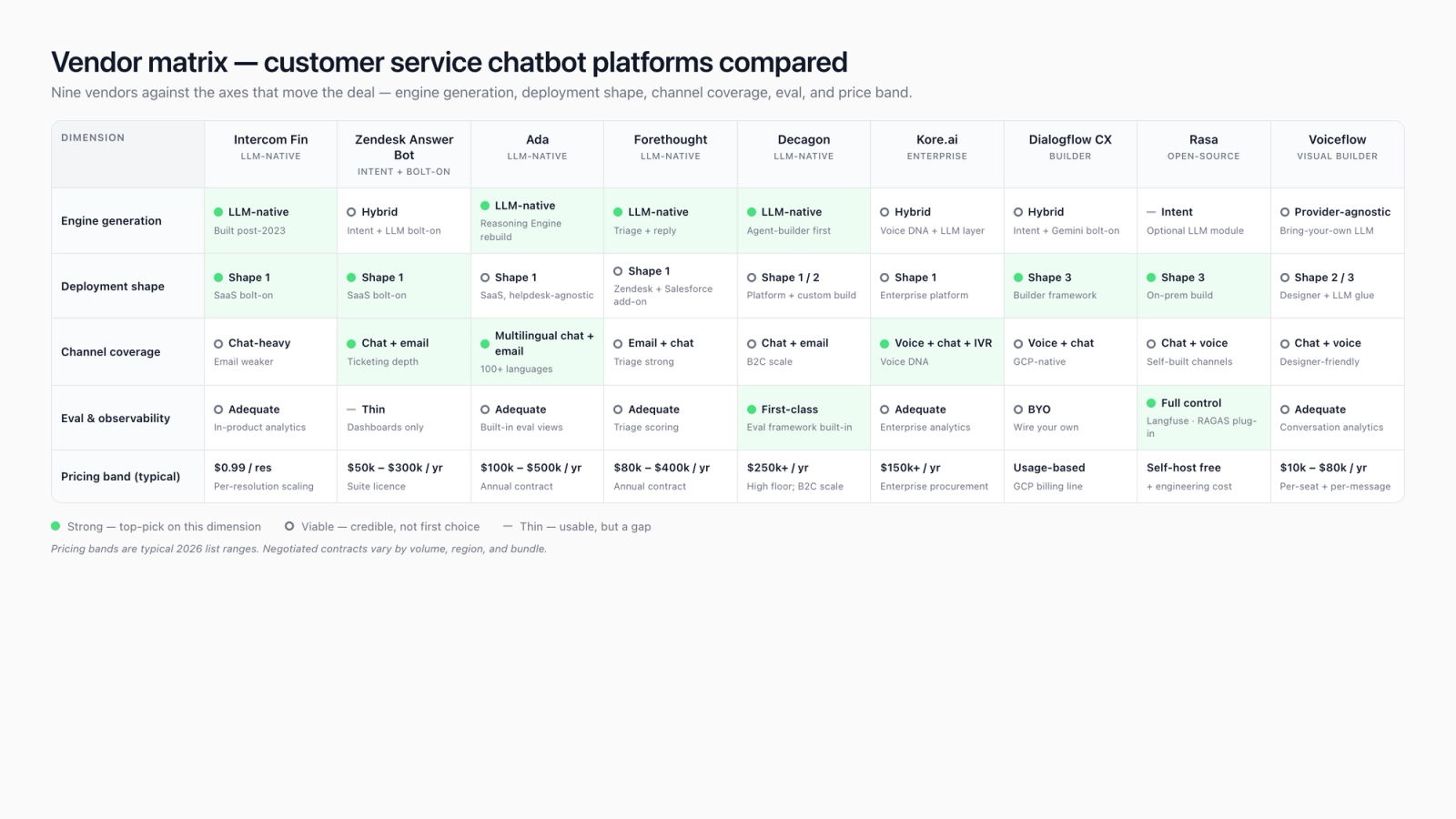
Every vendor we name below is one we've either specified into a brief, shortlisted, or ruled out in a 2025-2026 buying cycle. We're not affiliated with any of them. Prices we quote are list-price bands, not deal terms — and they shift quarterly, so always pull current pricing during the RFP. The single most useful filter we apply before reading any vendor deck is the engine-generation split. LLM-native vendors (the ones that built post-2023 on a language model from day one — Intercom Fin, Ada's Reasoning Engine, Forethought, Decagon, plus the LLM-first mode of Voiceflow) treat retrieval and generation as the primary control surface; intent-engine vendors (Zendesk's older Answer Bot lineage, Dialogflow CX, Rasa) treat the LLM as a generation layer bolted onto a taxonomy that still drives routing. On surface-level demos the two look nearly identical, because the LLM smooths over the seams. On a real RFP they pull apart fast. LLM-native vendors tend to win on out-of-the-box long-tail answer quality and degrade gracefully on questions the bot hasn't seen; intent-engine vendors tend to win on ticketing depth, macro integration, and procurement comfort, and they degrade more sharply when the customer asks something the taxonomy doesn't cover. Knowing which side a vendor sits on before the bake-off saves a fortnight of confused eval results.
| Vendor | Engine generation | Best for | Watch out for |
|---|---|---|---|
| Intercom Fin | LLM-native (built post-2023) | Mid-market SaaS already on Intercom; English-first; chat-heavy | Per-resolution pricing scales fast; lock-in to Intercom's KB schema |
| Zendesk Answer Bot (AI agents) | Intent-engine with LLM bolt-on; modernising fast | Teams entrenched on Zendesk with mature macros and triggers | Answer quality lags Fin and Decagon; eval scores soft on long-tail intents |
| Ada | Rebuilt LLM-native in 2023-2024 (Ada Reasoning Engine) | Multilingual support; non-English-first orgs; high-touch onboarding | Higher list price; thinner ticketing integration than Zendesk-native vendors |
| Forethought | LLM-native; tight Salesforce + Zendesk integrations | Triage and routing as much as deflection; agent-assist strong | Smaller market footprint; reference customers concentrated in SaaS |
| Decagon | LLM-native; agent-builder + eval framework first-class | High-volume CS teams with engineering bandwidth; B2C scale | Premium pricing; minimum spend can rule out sub-$5M support orgs |
| Kore.ai | Enterprise platform; voice + chat + IVR coverage | Large enterprise with voice-heavy support and procurement weight | Implementation time is enterprise-IT-paced, not weeks |
| Dialogflow CX | Intent-engine + Gemini generation bolt-on | GCP-native shops building their own; bring-your-own-engineering | Not a SaaS chatbot; it's a builder framework that needs a real dev team |
| Rasa | Open-source intent engine with optional LLM layer | Regulated orgs that need on-prem and full ownership | Heaviest engineering load of the set; not a buy, it's a build with a starter |
| Voiceflow | Visual builder; integrates with multiple LLM providers | Teams with a designer-led conversation team; rapid prototype to prod | Operational tooling thinner than Zendesk-native vendors |
The split that predicts the rest of the bake-off: LLM-native vendors (Intercom Fin, Ada, Forethought, Decagon, Voiceflow) tend to beat intent-engine-with-LLM-bolt-on vendors (Zendesk Answer Bot, Dialogflow CX, Rasa) on long-tail answer quality, and the gap shows up most clearly on questions the bot hasn't seen before. The older vendors win on ticketing depth and on procurement comfort. Choose for the gap you can't close yourself — answer quality is harder to backfill than ticketing integration.
Customer service chatbot implementation: a working RAG pipeline in code
Here's the smallest customer service chatbot implementation that we'd actually put in front of a customer. It's a hybrid-RAG (Shape 2): a Python service that listens to a Zendesk webhook, retrieves help-center articles from Pinecone, drafts a reply with Claude Sonnet 4.6, scores its own confidence, and either ships the reply or escalates with a transcript. About 200 lines, deployable in a week, and structurally close to what we ship into production.
from fastapi import FastAPI, Request
from anthropic import Anthropic
from pinecone import Pinecone
import zendesk_client

app = FastAPI()
anthropic = Anthropic()
pc = Pinecone()
index = pc.Index("support-kb")

SYSTEM = (
  "You are a customer service chatbot for ACME. Answer using ONLY "
  "the supplied KB passages. If the answer is not in the passages, "
  "output JSON: {\"action\": \"escalate\", \"reason\": \"...\"}. "
  "Otherwise output JSON: {\"action\": \"reply\", \"text\": \"...\", \"sources\": [...]}."
)

@app.post("/zendesk/ticket")
async def handle(req: Request):
  ticket = (await req.json())["ticket"]
  question = ticket["description"]

  # 1. retrieve top-5 KB passages
  hits = index.query(
    vector=embed(question), top_k=5, include_metadata=True
  )["matches"]
  passages = "\n\n".join(
    f"[{h['metadata']['title']}]\n{h['metadata']['body']}" for h in hits
  )

  # 2. generate reply with strict grounding
  resp = anthropic.messages.create(
    model="claude-sonnet-4-6",
    max_tokens=600,
    system=SYSTEM,
    messages=[{
      "role": "user",
      "content": f"PASSAGES:\n{passages}\n\nQUESTION:\n{question}"
    }]
  )
  out = parse_json(resp.content[0].text)

  # 3. ship or escalate
  if out["action"] == "reply":
    zendesk_client.add_comment(
      ticket["id"], out["text"], public=True
    )
    zendesk_client.set_tag(ticket["id"], "bot-resolved")
  else:
    zendesk_client.add_internal_note(
      ticket["id"],
      f"Bot escalated. Reason: {out['reason']}\n\n"
      f"Retrieved passages: {[h['metadata']['title'] for h in hits]}"
    )
    zendesk_client.assign_group(ticket["id"], "tier1-humans")

return {"status": out["action"]}import { StateGraph } from "@langchain/langgraph";
import { ChatAnthropic } from "@langchain/anthropic";
import { PineconeStore } from "@langchain/pinecone";
import { zendesk } from "./zendesk";
const llm = new ChatAnthropic({ model: "claude-sonnet-4-6" });
const store = await PineconeStore.fromExistingIndex(
embeddings, { indexName: "support-kb" }
);
async function retrieve(state: BotState) {
const hits = await store.similaritySearch(state.question, 5);
return { passages: hits };
}
async function generate(state: BotState) {
const passages = state.passages
.map(h => `[${h.metadata.title}]\n${h.pageContent}`)
.join("\n\n");
const r = await llm.invoke([
["system", SYSTEM],
["user", `PASSAGES:\n${passages}\n\nQUESTION:\n${state.question}`]
]);
return { decision: JSON.parse(r.content as string) };
}
async function ship(state: BotState) {
if (state.decision.action === "reply") {
await zendesk.addComment(
state.ticketId, state.decision.text, { public: true }
);
} else {
await zendesk.escalate(
state.ticketId, state.decision.reason, state.passages
);
}
}
const graph = new StateGraph(BotState)
.addNode("retrieve", retrieve)
.addNode("generate", generate)
.addNode("ship", ship)
.addEdge("retrieve", "generate")
.addEdge("generate", "ship")
.compile();Four engineering details earn their keep in this shape. The system prompt forces strict grounding, so the bot can't answer outside the passages, which is what keeps hallucinations off your CSAT scorecard. The model emits structured JSON, which means the deploy/escalate branch is a switch statement and not a regex over free text. The escalation note includes the retrieved passages, so the human agent isn't starting from zero. And the bot tags every resolved ticket with bot-resolved, which is how you'll measure deflection cleanly six weeks later.
Three things we haven't shown that you'll need in week three: a confidence threshold (a calibrated score from a second classifier call to gate auto-shipping versus draft-for-agent), an eval harness (RAGAS or Langfuse with offline ticket replay), and an evaluation cadence (a weekly review of escalated tickets where the bot was wrong, fed back into the KB). Without those three, the bot drifts inside six weeks and your CSAT walks.
The evaluation framework: how we score a customer service chatbot against a real support brief
We score a customer service chatbot vendor or build along six axes during a bake-off. It's an opinionated list. There are more axes you could add, but these six surface the differences that matter inside a quarter of running the bot in production.
| Eval axis | Why it matters | How to score |
|---|---|---|
| Grounded answer quality | The bot must answer from your KB, not from training data | Replay 200 historical tickets; manually score factual + complete + grounded on 1-5 |
| Escalation transcript quality | An agent picking up a handoff should be net-better than starting cold | Take 50 escalations; agent-rated 'helpful or hindering' on 1-5; score = mean |
| Latency at p95 | Chat falls off a cliff past 4-5s; voice past 800ms | Synthetic load test 1000 concurrent; measure p50/p95/p99 |
| Cost per resolved contact | Pricing model decides whether the bot scales past 100k tickets/mo | Model 10k, 50k, 250k tickets/mo; cost stays linear, score 3 |
| LLM provider portability | The 2024 OpenAI outage took down half the vendor-locked bots | Can the bot run on Anthropic and OpenAI without re-engineering? If yes, score 3 |
| Eval + observability | Without traces, you can't diagnose why CSAT dropped in week eight | Per-conversation trace with retrieval + generation + final action — does vendor ship this? Yes = score 3 |
Two pitfalls on eval. First, don't score on synthetic questions a vendor PM wrote; replay 200 of your own historical tickets and grade those, because synthetic data hides the long-tail failure modes that wreck CSAT. Second, score escalation quality with the actual support agents who'll receive the handoffs, not with the procurement team. Agents will flag transcript problems that nobody else can see — the missing context, the wrong tag, the apology the bot tried to write.
Buy a SaaS chatbot, build your own, or assemble: where each option earns its keep
Every customer service chatbot brief lands on the same three-way decision. Buy a SaaS chatbot (Shape 1). Assemble a hybrid stack (Shape 2). Or build your own (Shape 3). We've watched teams pick the wrong shape and rebuild within twelve months — most of those teams over-built on the first try. Here's where each shape earns its fee.
| Earns its fee when… | Wastes your money when… | |
|---|---|---|
| Buy SaaS (Intercom Fin, Zendesk Answer Bot, Ada) | English-first, <50k tickets/mo, mature KB, helpdesk-entrenched team, no engineering bandwidth for the bot | Multilingual, custom data sources, voice in scope, or your KB is too thin for the bot to ground |
| Assemble (hybrid RAG) | Multilingual, custom data, you have a small platform team, you want LLM swap-out and own eval | Team has no eng to operate the retrieval service, or volume is too low to justify even one engineer |
| Build your own (LangGraph + Pinecone + Twilio) | Voice + chat + multi-system routing, regulated audit needs, willing to invest 6+ engineer-months | Mid-market SaaS that doesn't need voice — you'll pay enterprise costs for a feature you don't use |
The economics most vendor decks skip: cost-per-resolved-contact, deflection, and the deflection-quality tax
Vendor decks report deflection rate because it's the number that looks best on a slide. The number procurement actually approves is fully-loaded cost-per-resolved-contact at a CSAT floor. Here's the math we walk every brief through. Take your fully-loaded human-agent cost-per-contact (typical mid-market North America band, $8-$12 including overhead). Multiply by your monthly volume. That's your support cost base. A customer service chatbot that deflects 30% of contacts at $0.15 each cuts the base by roughly 27% net of bot cost — but only if the escalated 70% don't get worse. If escalated AHT climbs 20%, the deflected savings shrink to about 15%. If CSAT on escalations drops below your threshold, you've spent money to make the support experience worse.
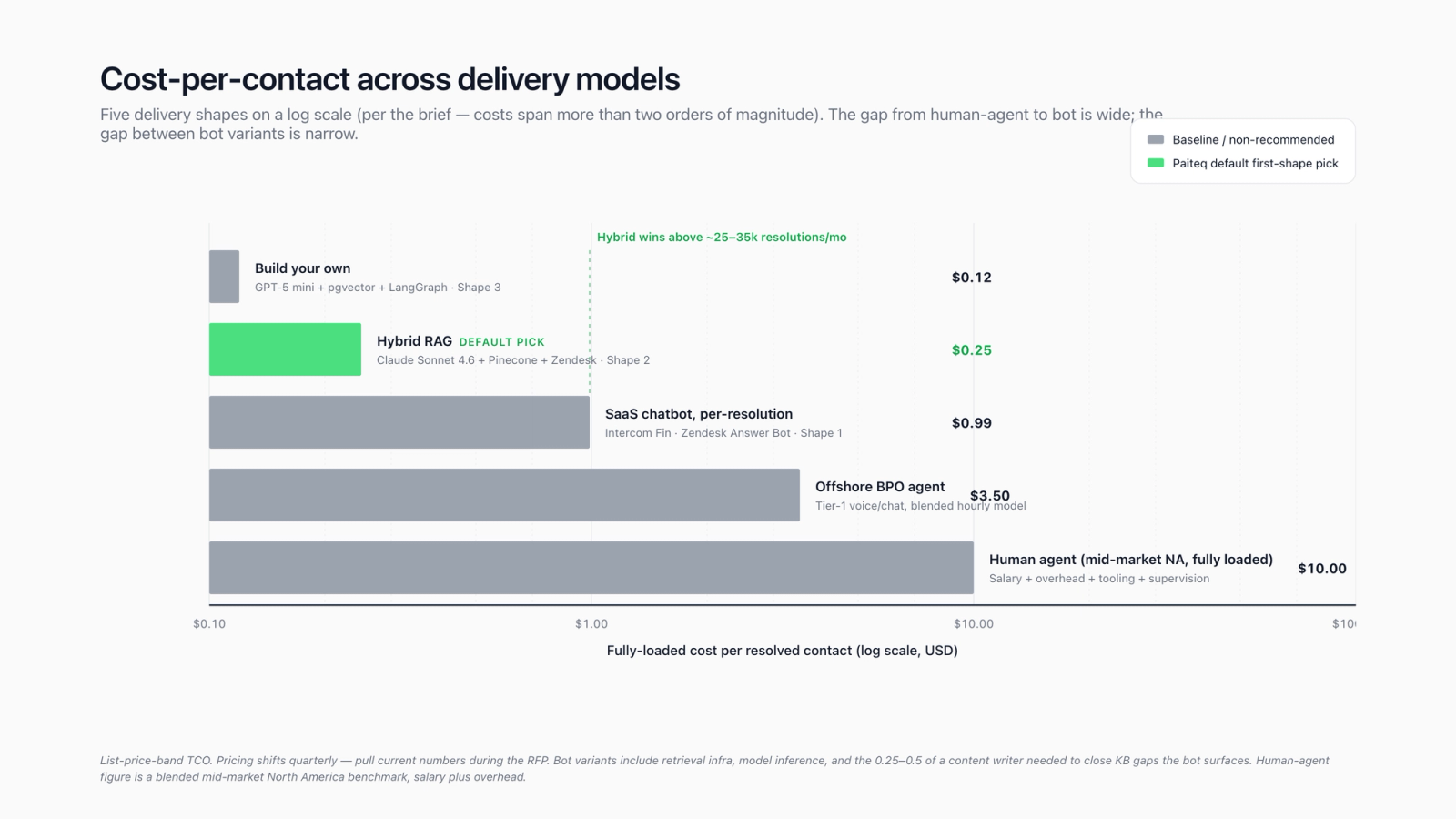
Two of those numbers deserve a second look. SaaS chatbots on a per-resolution model (Intercom Fin's pricing shape is the canonical example) typically land $0.70-$1.50 per resolved contact at list price. That's a fine deal at low volume; past about 30k resolved contacts a month, the same workload on a hybrid RAG stack costs less than a third. The break-even between SaaS and hybrid sits around the 25-35k monthly resolutions mark for most teams we've modelled — that's the threshold to push back on if a vendor's pricing scales linearly with volume.
And don't forget the hidden cost most decks skip: the KB-maintenance work that a customer service chatbot generates. A good bot exposes content gaps every week — questions the bot couldn't ground, articles it answered wrong from, articles that contradict each other. Closing those gaps takes content-ops time, typically 0.25-0.5 of a content writer in year one. We bake that into the TCO model on every brief, because the teams that don't end up with a bot that drifts inside six months.
Best customer service chatbot picks for three real buyer profiles
There isn't one best customer service chatbot. There's a best pick for each buyer profile. Below are three profiles we see most often, and the shortlist we'd ship into each one. We're naming product names, not retainers, so this list dates inside a year — pull it up against current pricing during the actual RFP.
Notice what's not on any of these lists: a single vendor that wins everywhere. The vendors that pitch themselves as universal customer service chatbot platform are the ones we ask the hardest questions of during a bake-off — usually they've got two strong axes and a weak third one, and the weak axis is the one your team will hit by month six.
The customer service chatbot guide: a 7-step rollout checklist for the first 90 days
If you've signed a vendor or kicked off a build, here's the customer service chatbot guide we hand to clients for the first 90 days. It's seven steps, not thirty. The point isn't to be comprehensive — it's to hit the four things that decide whether the rollout earns its quarter.
Frequently asked questions about customer service chatbot rollouts
What is a customer service chatbot in plain language?
A customer service chatbot is an automated layer on top of your helpdesk — Zendesk, Intercom, Salesforce Service Cloud, Freshdesk — that reads inbound support messages, drafts replies grounded in your knowledge base, and either ships the reply to the customer or hands the conversation to a human agent with full context. In 2026 the canonical engine is a language model (Claude Sonnet 4.6, GPT-5 mini, Gemini 3.0 Flash) plus retrieval over your help-center content; the older intent-classifier shape is being phased out across the vendor landscape.
How is a 2026 customer service chatbot different from the one we tried in 2019?
The 2019 customer service chatbot used intent classification on a fixed taxonomy — you told it about thirty intents, it routed accordingly, and anything off-script failed silently. The 2026 chatbot uses a language model with retrieval, which means it doesn't need the taxonomy. It reads the customer's actual question, fetches the relevant help-center articles, and drafts a grounded answer. Out-of-the-box answer quality is dramatically higher, the failure mode shifts from silent miss to noisy escalation, and the maintenance work moves from intent-curation to KB-curation.
What's the best customer service chatbot for mid-market SaaS?
For mid-market SaaS at 20-50k tickets a month, our shortlist is Intercom Fin (if you're already on Intercom), Zendesk's newer AI agents (if you're on Zendesk), or a Shape 2 hybrid RAG build on Claude Sonnet 4.6 with Pinecone retrieval. Pick SaaS if you're under 25k resolutions a month, the helpdesk is entrenched, and English-first is fine. Pick hybrid if you're above that volume, you need multilingual, or you want LLM swap-out without a vendor renegotiation.
How do we calculate ROI on a customer service chatbot?
The right unit is fully-loaded cost-per-resolved-contact at a CSAT floor, not deflection rate. Take your typical human-agent cost-per-contact (mid-market North America runs $8-$12 fully loaded), multiply by monthly volume, then model the bot's contribution at its deflection rate net of bot cost. Adjust down for the escalation-quality tax — if escalated AHT climbs, savings shrink. Add back the KB-maintenance content-ops cost (0.25-0.5 of a writer typically). What's left is real ROI; what's reported on most vendor decks is gross deflection, which over-states by 30-60% in our experience.
What does customer service chatbot architecture actually look like under the hood?
Three reference shapes. Shape 1 (SaaS bolt-on) is Intercom Fin or Zendesk Answer Bot — vendor hosts the model and retrieval; you turn it on inside the helpdesk. Shape 2 (hybrid RAG) keeps the helpdesk as the control plane but routes the model call to a service you own that retrieves from Pinecone or pgvector and calls Claude or GPT-5 mini. Shape 3 (build your own) replaces the bot layer entirely with a LangGraph or Anthropic Agent SDK orchestration over your own stack. Most mid-market briefs land on Shape 2; Shape 3 is for voice, multi-system routing, or regulated audit needs.
How long does a customer service chatbot implementation take?
Shape 1 (SaaS bolt-on) is hours to days for the technical work; the real timeline is 4-6 weeks for KB cleanup and eval setup. Shape 2 (hybrid RAG) is 10-14 weeks from kickoff to a single-channel production launch, including the eval pipeline and the first KB-gap loop. Shape 3 (build your own) is 16-26 weeks depending on channels in scope. Whichever shape you pick, plan for an additional quarter of soft-launch and intent-widening before you've claimed the full first-year deflection.
Should we build a customer service chatbot ourselves or buy one?
Buy SaaS if you're English-first, under 50k tickets/mo, on a mature helpdesk, and short on engineering bandwidth. Assemble (Shape 2 hybrid) if you have a small platform team, multilingual or custom data needs, and want LLM swap-out without a vendor renegotiation. Build (Shape 3) only when voice, multi-system routing, or regulated audit are in scope — the engineering investment is real and the payback past 12 months. Most teams that build on a first project regret it; most teams that buy on a fifth project regret that, too. Match the shape to the brief, not to the team's ambition.
Specifying a customer service chatbot build for 2026?
We help support and engineering leads pick an architecture, score the vendor matrix, and ship the first production rollout in weeks instead of quarters.