Diffusion model vs flow matching: a 2026 buyer guide
A 2026 buyer and builder guide to the diffusion model paradigm — flow matching, diffusion model architecture, sampling cost, and what to ship.


A diffusion model is a generative system that learns to invert a known noising process. You take real data, add Gaussian noise across many timesteps until the signal is destroyed, then train a neural network to predict and remove that noise step by step. Run the network in reverse from pure noise and you get a sample. That mechanic, formalised by Ho and colleagues in 2020 as DDPM, is what now sits inside Stable Diffusion 3 alongside Flux as well as the closed video stacks (Sora, Veo) and Imagen, and powers most production image and video pipelines shipping in 2026.
Two things have changed since the textbook version of the story. First, flow matching, in particular rectified flow as published by Lipman and by Liu in 2023, now beats classical diffusion on sample efficiency and is the default training objective inside Stable Diffusion 3 and Flux. Second, sampling cost stopped being an academic curiosity and became the only deployment number anyone in our engineering conversations actually cares about. NFE per generation, the wall clock on an H100, the batch math behind a Runware or Replicate or Fal invoice. That's the post you're reading: a paired buyer and builder guide to the diffusion model paradigm in 2026, written for the Tech Lead who has to bet a roadmap on it.
Diffusion model, in one minute
Working definition: a diffusion model learns the gradient of the log data density (the score) by training a neural network to denoise samples that have been progressively corrupted with Gaussian noise. You can read the same object as a hierarchy of denoising autoencoders or as a score-based SDE or as a variational latent-variable model. The three framings are mathematically equivalent. Song and Ermon proved the score-based view; Ho gave us DDPM; the SDE picture from Song et al. unified them.
What changed since 2023 is the training objective. Classical diffusion regresses against the noise residual at every timestep. Flow matching, the cousin paradigm that now ships inside Stable Diffusion 3 and Flux, regresses against a velocity field on a continuous-time trajectory between noise and data. The sampler at inference time is an ODE solver instead of an SDE walker. Both produce identical-looking images from identical-looking backbones (DiT or MM-DiT or UNet). The training math is what makes them cheaper to sample.
We'll use diffusion model in this post as the umbrella term that covers both classical denoising diffusion and flow matching, because that's how teams shipping with HuggingFace Diffusers and PyTorch talk about it in practice. Where the two paradigms diverge enough to matter, we'll say so explicitly.
How a diffusion model actually works (forward and reverse, no math wall)
The forward process is a Markov chain that adds Gaussian noise over a fixed schedule of timesteps. Ho et al. ran 1000 timesteps with a linear beta schedule from 1e-4 to 0.02; Nichol and Dhariwal improved this with a cosine schedule a year later. By the final timestep, the signal is indistinguishable from pure noise. Crucially, you don't actually run the forward chain at training time. The reparameterisation trick gives you a closed-form sample of any timestep from x_0 directly, which is why DDPM training fits on a single H100 for small models.
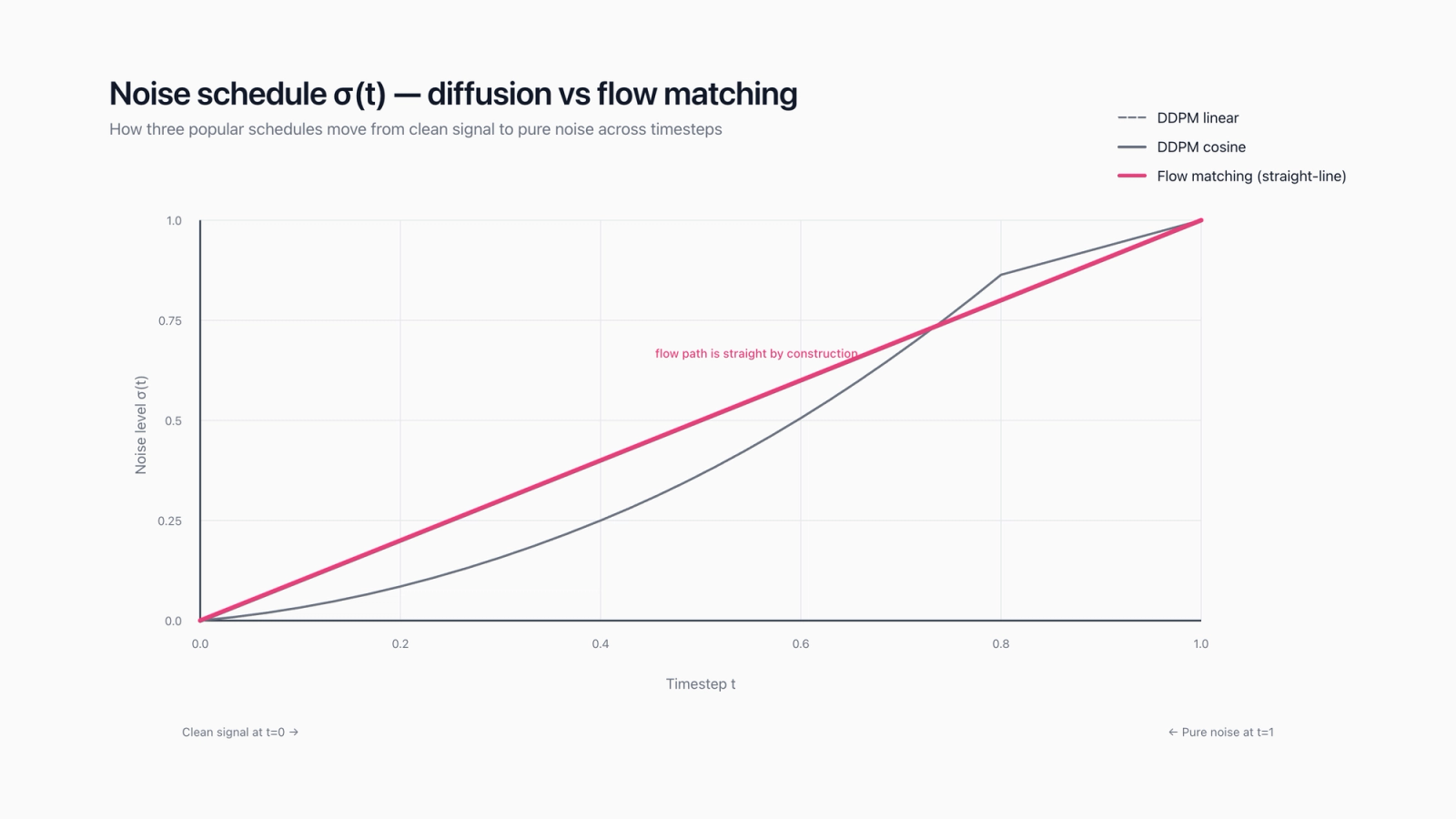
The reverse process is where the neural network earns its keep. You train a denoiser, conventionally written epsilon-theta, to predict the noise that was added at timestep t given the noisy sample x_t. At inference, you start from pure Gaussian noise and call the denoiser once per sampler step, subtract the predicted noise (with a small Langevin-style perturbation if you're doing SDE sampling), and step backwards. DDIM, the deterministic shortcut from Song and Ermon, lets you skip timesteps cleanly and brought the canonical sampler count down to about 50 NFE. Newer ODE solvers like DPM-Solver and UniPC together with the Heun integrator that ships with EDM2 push that lower without retraining.
# Minimal DDPM training step, PyTorch + HuggingFace Diffusers conventions.
import torch
from diffusers import UNet2DModel, DDPMScheduler

model = UNet2DModel.from_pretrained("google/ddpm-celebahq-256")
scheduler = DDPMScheduler(num_train_timesteps=1000, beta_schedule="linear")

def training_step(x0, model, scheduler):
    # Sample a timestep per item in the batch.
    bsz = x0.shape[0]
    t = torch.randint(0, scheduler.config.num_train_timesteps, (bsz,), device=x0.device)
    # Sample noise and produce x_t in closed form.
    noise = torch.randn_like(x0)
    x_t = scheduler.add_noise(x0, noise, t)
    # Predict the noise residual.
    pred = model(x_t, t).sample
    # MSE on the noise. The whole training objective fits on one line.
return torch.nn.functional.mse_loss(pred, noise)Two intuitions are worth burning into memory. One: every sampler step is one forward pass of the same network, so wall-clock cost scales linearly with NFE. A 50-step DDIM run is 50 network calls per image. Two: the conditioning signal (a text embedding from a T5 or CLIP encoder, a class label, a ControlNet hint) is concatenated or cross-attended at every step. Classifier-free guidance, the trick that gives you sharper conditional samples, doubles your NFE because you run the network conditionally and unconditionally at each step.
Flow matching: the alternative that ate half the field
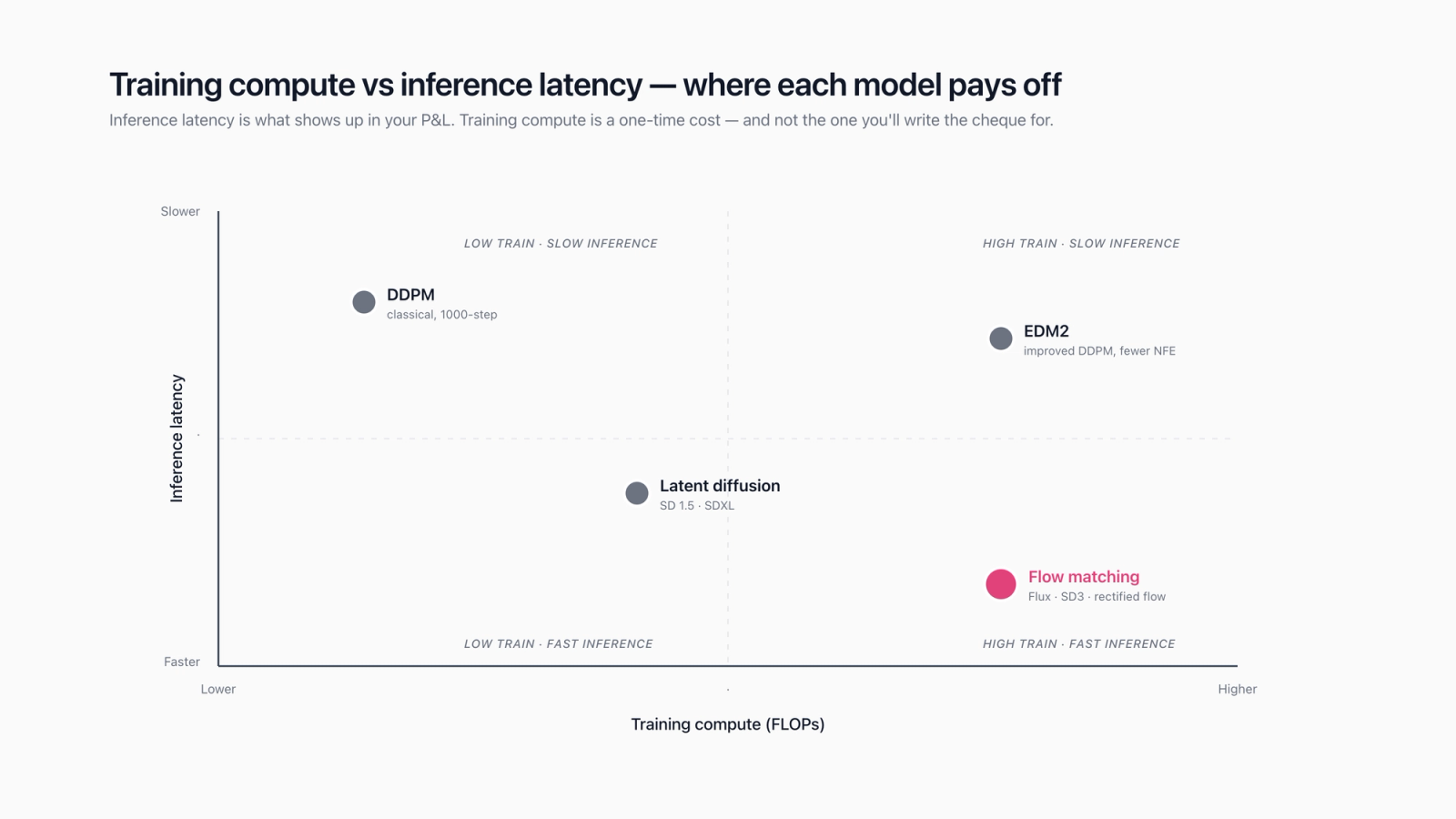
Conditional flow matching, the practical recipe published in 2023 by Lipman and by Tong and by Liu, gives you a regression target that is a marginal velocity. The training loop is genuinely simpler than DDPM. Sample a data point, sample a noise point, sample a time t in [0,1], linearly interpolate, regress the velocity. That is the whole objective. Stable Diffusion 3 from Stability AI uses this recipe; so does Flux from Black Forest Labs. Both teams reported better sample efficiency than their diffusion siblings at fixed compute, which is why the rectified-flow camp now has the momentum.
Why does the straight-line ODE matter? Because solver error compounds along curved trajectories. A DDPM reverse process curls through latent space; a rectified-flow ODE goes from A to B in something close to a line. Each Euler step covers more useful distance, so you need fewer of them to land inside the data manifold. Tong and colleagues showed that even a 2-step rectified-flow sampler beats a 10-step DDIM run on FID for small image benchmarks. The diffusion paradigm isn't dead, but for new image and video projects starting in 2026 the burden of proof is on the team choosing classical DDPM over a flow-matching variant in HuggingFace Diffusers or in a JAX-based research stack.
Diffusion model architecture choices that matter in 2026
The backbone of every shipping diffusion model is either a UNet, a DiT (diffusion transformer, Peebles and Xie 2023), or an MM-DiT (multimodal DiT, introduced with Stable Diffusion 3). UNets are the legacy choice and still dominate small-to-medium image models because of their inductive bias toward locality. DiTs scale better with parameters and compute, which is why every model above the 2B-parameter line (Sora and Veo on the closed side, Imagen 3 and SD3 on the published side), has moved to a transformer backbone. MM-DiT adds separate parameter streams for the text and image tokens that meet inside the attention blocks, which lets the model spend capacity on text understanding without polluting visual features.
The other axis is latent vs pixel. Latent diffusion, the Rombach et al. 2022 idea that gave us Stable Diffusion, runs the denoiser inside a VAE-compressed 64x64 or 128x128 latent grid instead of the raw 1024x1024 pixel canvas. That cuts compute by roughly an order of magnitude per step and is the only reason real-time image generation on a single H100 is feasible. Pixel-space models like Imagen still produce sharper fine detail in some categories, but the production economics are brutal: the larger the canvas, the deeper the latent compression you need to keep serving costs predictable. EDM2 from Karras and colleagues at NVIDIA is the reference for how to train a clean pixel-space diffusion model when you do need it.
Conditioning paths are the third decision. Cross-attention from a T5 or CLIP text encoder is the standard for text-to-image. ControlNet plus T2I-Adapter plus IP-Adapter give you extra conditioning channels for pose, depth, edges, or reference images, with no retraining of the base model. For brand and product use cases we usually pair a base diffusion model with a small LoRA, which fits inside a few hundred megabytes and trains in an afternoon. The longer story on that approach lives in our piece on fine-tuning a model on your brand visuals. The shape of the conditioning is also where most production diffusion model architecture decisions actually land, because it determines whether you can keep one base checkpoint and ship many product variants on top of it.
Named diffusion model examples: what is actually shipping
The roster below is the short list we walk a client through when they ask which checkpoint to anchor a 2026 generation system on. None of these are research artefacts; all of them are available either as open weights on HuggingFace or as a hosted API on Replicate, Fal, Runware, or Stability's own platform. The headline pattern across the diffusion model alternatives we walk through below: open-weight rectified-flow models (SD3, Flux) now match or beat the closed image stacks for most product use cases, and the closed lead has moved upmarket into video (Sora, Veo) and very long-form audio.
| Image and video diffusion models | Where each fits | |
|---|---|---|
| Stable Diffusion 3 (2B / 8B) | MM-DiT, rectified flow, open weights | Best open-weight option for branded image generation in 2026 |
| Flux.1 (Schnell / Dev / Pro) | MM-DiT, rectified flow, open + hosted | Strongest prompt adherence among open models; Schnell is the few-step distilled variant |
| EDM2 (Karras et al.) | Pixel UNet, classical diffusion, NVIDIA reference | Reference architecture if you're training your own pixel model |
| Sora (OpenAI) | DiT, latent video, closed | Long-form text-to-video; closed weights, hosted only |
| Veo (Google DeepMind) | DiT, latent video, closed | Direct Sora competitor with stronger camera control |
| Imagen 3 (Google) | Pixel-space diffusion, closed | Strong photography and typography rendering; API only |
| Stable Video Diffusion | Image-to-video DiT, open | Cheap path to short-form video from a single still |
| MovieGen (Meta) | DiT, audio + video, research | Strongest joint audio-video research stack; weights not released |
For most teams a useful framing is: pick an open-weight base from the SD3 or Flux family if you want control, hostability, and fine-tunability; pick Sora or Veo through the official APIs if you need long-form video and can accept closed weights; pick Imagen 3 through Vertex AI if you're deep in the Google Cloud stack. Runware (and Replicate or Fal) will serve any of the open-weight options at predictable per-second pricing, which is the cheapest path to a production-grade diffusion model examples catalogue without the headcount to run your own GPU fleet.
On hosted pricing, the three commodity players we benchmark against each other every quarter are Replicate, Fal, and Runware. In 2026 the per-second rates for an SD3 Medium or Flux Dev generation on an H100-class GPU land in roughly the same band across all three: somewhere between $0.001 and $0.003 per second of GPU time, depending on the cold-start posture and whether you're paying for a warm pool. Replicate tends to sit at the higher end on convenience and breadth of model catalogue; Fal aggressively prices the few-step distilled variants (Flux Schnell, SD3-Turbo) toward the lower end on dedicated H100s; Runware quotes a per-second number that is usually the cheapest at sustained throughput but assumes you can keep the queue warm. A 1024x1024 Flux Dev generation at 10 NFE is roughly a 1-to-3 second wall clock on an H100, which puts a single image somewhere in the $0.001 to $0.01 range at list. Always check the vendor's current docs before committing — these numbers move every quarter as new distilled checkpoints land — but the order-of-magnitude framing is stable enough to size a P&L.
On open-vs-closed for enterprise procurement, the trade-off is no longer about quality (SD3 Medium and Flux Dev are competitive with Imagen 3 on most product imagery) but about licensing, redistribution, and fine-tuning rights. Three questions we make procurement teams ask before they sign. One, what does the model licence say about commercial use, derivative works, and re-distribution of LoRA fine-tunes? Stability's licence on SD3 has been revised twice; Black Forest Labs ships Flux Dev under a non-commercial licence with a separate Pro tier for paid commercial use. Two, what dataset provenance documentation does the vendor publish, and does it satisfy your jurisdiction's training-data disclosure rules (the EU AI Act draft is the strictest example)? Closed weights from Sora and Veo give you almost nothing on this axis; open weights at least let your legal team see the model card. Three, can you fine-tune on customer data without sending that data to the vendor's API? Open weights make this trivial; the closed stacks force a managed fine-tune flow where your data crosses the vendor's tenancy boundary, which is a non-starter for regulated industries. The procurement spreadsheet for a 2026 generative AI build looks more like an MSA review than a model evaluation.
Diffusion model vs flow matching: a decision matrix by modality
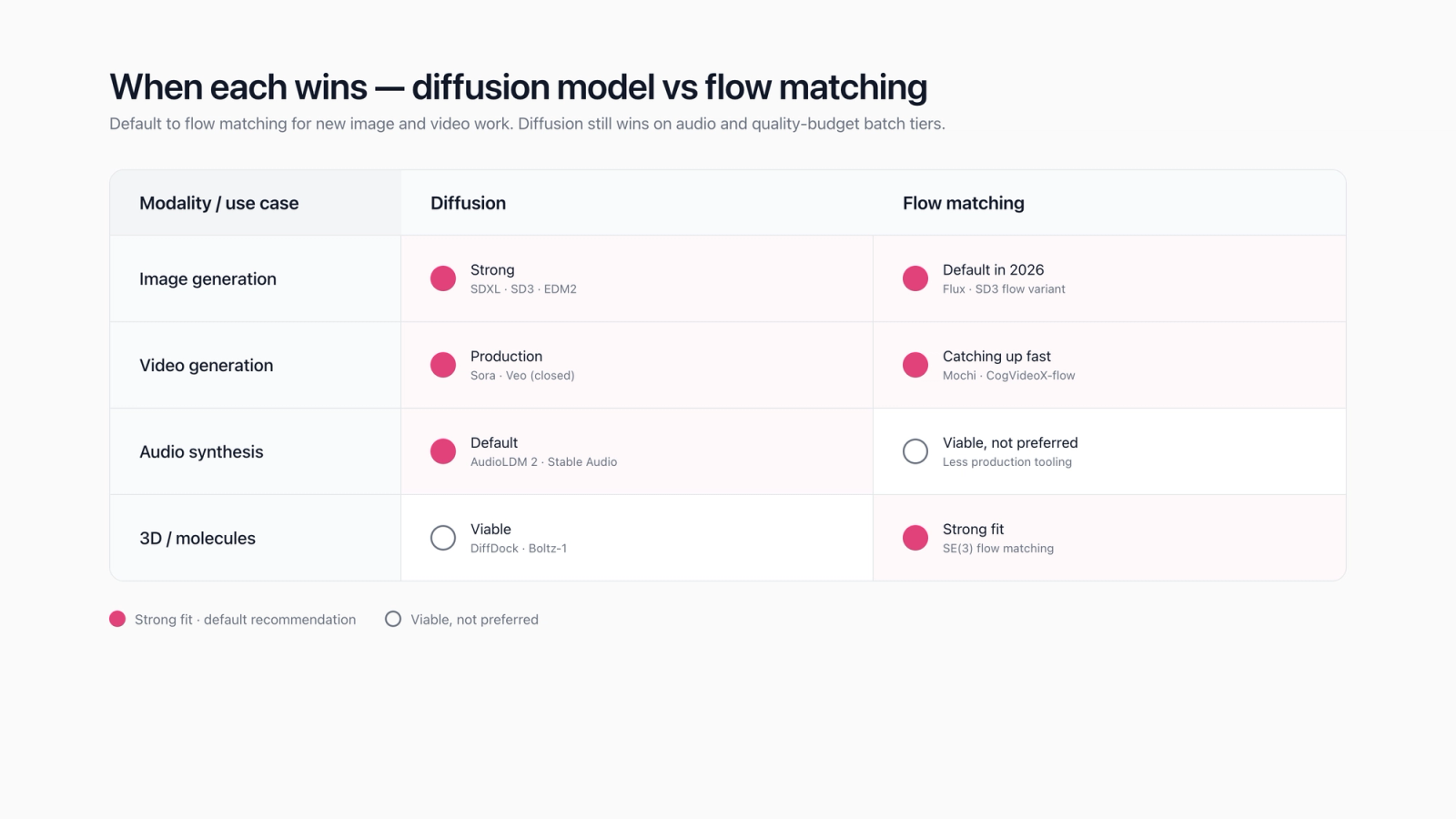
Below is our diffusion model comparison by modality, scored the way we score it in client conversations. The decision is rarely abstract. A buyer arrives with a modality (image, video, audio, 3D or molecular), a latency budget, and a quality bar. The honest framing is that classical diffusion and flow matching are both viable across every modality, but the fit is uneven. Below is how we score the four common axes in client conversations.
| Modality | Classical diffusion (DDPM / EDM) | Flow matching (rectified flow) |
|---|---|---|
| Image generation | Strong; mature tooling, EDM2 reference | Stronger; SD3 and Flux now lead on FID per FLOP |
| Video generation | Used in early Sora and SVD; viable but heavy | Preferred for new builds; fewer steps at 1080p |
| Audio synthesis | Default; AudioLDM and Stable Audio anchor here | Viable in research; production stacks have not moved |
| 3D / molecules | Used in early Boltz and diffusion docking; viable | Preferred; SE(3) flow matching is the 2025-26 default |
Two notes on this matrix. First, audio is the one place we still default to classical diffusion in 2026. Stable Audio Open, AudioLDM 2, and Meta's MAGNeT line all use DDPM-style training, and the few flow-matching audio papers have not produced a checkpoint with comparable controllability. Second, in molecular and 3D shape generation, SE(3) flow matching has taken over almost completely; the Boltz-1 protein-structure model and the follow-on docking pipelines are flow-matching under the hood. If your problem looks more like protein design than like image generation, don't start from a DDPM textbook.
The other axis the matrix doesn't show is latency budget, which is what actually decides the sampler-and-checkpoint pair you ship. We sort engagements into three tiers and pick the stack from the tier, not from the modality.
Tier one, sub-100ms interactive. The use case here is typing-while-they-watch: a designer is dragging a slider or refining a prompt and expects the image to update on every keystroke. There is exactly one sampler family that lands inside this budget on a single H100 today, and it is the few-step distilled variants. LCM (Latent Consistency Models) or SD3-Turbo at 4 NFE on a 512x512 latent canvas with the VAE decoder cached across the batch is the recipe. Flux Schnell is the closest open-weight equivalent. You give up a small but visible amount of detail at this tier — distilled samplers smear high-frequency texture more than their teacher — but you gain the interactive UX that lets the product feel like a creative tool instead of a render farm.
Tier two, sub-1s chat-style. The use case is a chat tool where the user sends a prompt and waits for a single high-quality image inside the response. Heun ODE sampler on Flux Dev at 10 NFE, fp16 weights, 1024x1024 latent canvas, classifier-free guidance off in the latency path. That stack lands at roughly 1 second per image on an H100 and is what we recommend by default for almost every chat-grade product surface. The quality is within touching distance of the 50-step teacher and the cost per image is predictable enough to put inside a per-message unit economics model.
Tier three, batch async. The use case is a background renderer behind a CMS, a print-quality marketing asset pipeline, or a video frame batch. Latency budget is measured in tens of seconds per generation and quality is the only number anyone cares about. SD3 Medium or Flux Dev at 25 NFE with a DPM-Solver++ second-order sampler, guidance on at 7.5, full 1024x1024 latent, optionally followed by an SDXL-based refiner pass. We turn classifier-free guidance back on and stop trying to skip steps. This is the tier where the quality difference between rectified flow and classical diffusion almost disappears in human eval, and the right choice usually comes down to which checkpoint your team already has a LoRA stack on top of.
Sampling cost is the whole game
Training compute is a one-time write-off that an enterprise buyer doesn't pay if they're starting from an open-weight checkpoint. Inference compute is in their P&L every month. The number that matters is NFE per generation multiplied by network FLOPs per pass, multiplied by batch density on the target GPU. NFE is the lever you can pull without retraining; everything downstream of the architecture choice flows from it. Across our engineering reviews, this is the single calculation product teams get wrong most often, because the academic literature reports FID-at-best-NFE numbers and quietly assumes you can afford 50 to 250 NFE per sample.
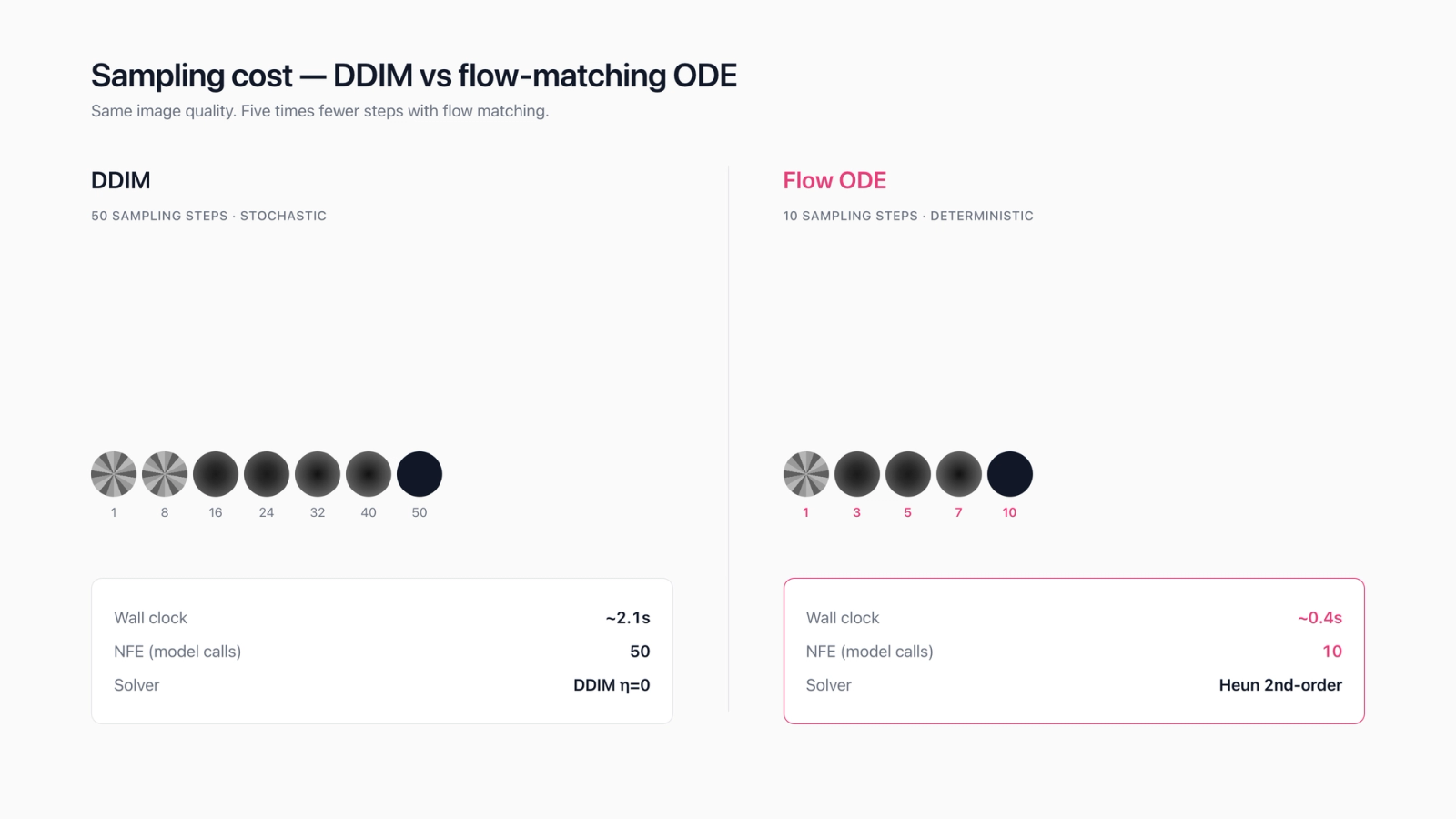
Two practical implications. One, distillation is the highest-leverage optimisation a serving team has after picking a backbone. Latent Consistency Models, ADD (SD3-Turbo), and progressive distillation can collapse a 50-step DDIM run into a 2 to 4 step generator with a small quality hit and a much larger cost win. Two, classifier-free guidance doubles your effective NFE because you run the network twice per step. For low-latency UX flows we routinely turn guidance off and rely on a stronger conditioning encoder or a LoRA, which keeps the wall clock predictable on a single H100 with fp16 weights.
The pragmatic takeaway: in a typical 2026 engagement we ship with a flow-matching backbone (SD3 Medium or Flux Dev), a Heun ODE sampler at around 10 NFE, fp16 weights on an H100, and guidance turned off in the latency-critical path. That stack gives a 1024x1024 image generation in roughly the same wall clock as a single small-LLM token decode. The closed video stacks (Sora, Veo) will be more expensive per generation by an order of magnitude, but the same NFE arithmetic applies inside their hosted pricing. For a deeper view on safety and provenance once that pipeline is live, see our piece on provenance and safety controls for generated media. For a build-vs-buy frame on the surrounding services, see how teams typically evaluate a generative AI engagement.
Diffusion model implementation: a working stack
A pragmatic diffusion model implementation for a product team in 2026 leans on three building blocks. PyTorch as the framework. HuggingFace Diffusers as the pipeline layer (schedulers, samplers, conditioning glue, ControlNet adapters, a clean abstraction for safety checkers). The Karras EDM2 repo as the reference codebase if you are training from scratch, and a research stack like JAX or Flax if you want to follow the flow-matching literature where Google DeepMind and Stability researchers publish first.
# Standard DDIM inference on an open-weight checkpoint.
import torch
from diffusers import StableDiffusionPipeline, DDIMScheduler

pipe = StableDiffusionPipeline.from_pretrained(
    "stabilityai/stable-diffusion-2-1",
    torch_dtype=torch.float16,
).to("cuda")
pipe.scheduler = DDIMScheduler.from_config(pipe.scheduler.config)

# 50 NFE is the legacy default; halve it as quality allows.
image = pipe(
    prompt="a glass building reflecting a clear evening sky, editorial photography",
    num_inference_steps=50,
    guidance_scale=7.5,
).images[0]
image.save("out.png")# Rectified-flow ODE sampler, JAX-style, 10 steps to a sample.
import jax
import jax.numpy as jnp
from jax.experimental.ode import odeint
def sample(model_apply, params, key, x_shape, n_steps=10, cond=None):
# Start from Gaussian noise at t=1.
x1 = jax.random.normal(key, x_shape)
def velocity(x, t):
# Model predicts the rectified-flow velocity field.
return model_apply(params, x, jnp.full((x.shape[0],), t), cond)
# Integrate the ODE from t=1 back to t=0 in n_steps.
ts = jnp.linspace(1.0, 0.0, n_steps + 1)
xs = odeint(velocity, x1, ts, rtol=1e-3, atol=1e-3)
return xs[-1] # x at t=0 is the sample
Three implementation traps we see repeatedly. First, mixed precision is not free: fp16 weights with fp32 attention accumulation is the safest default; pure bf16 saves more memory but bites you on long video sequences. Second, the VAE decoder is often the dominant latency stage at small NFE counts; cache it across a batch when you can. Third, classifier-free guidance changes effective batch size and should be folded into your throughput math before you size the cluster. A serving team that misses this routinely under-provisions GPUs by half.
If you are training rather than serving, the production playbook today is closer to the LLM playbook than it was three years ago. FSDP or DeepSpeed for sharding, ZeRO-2 for the optimiser state, gradient checkpointing on every attention block, and a careful EMA schedule for the weights you actually deploy. The machine learning development services required to run EDM2 at scale looks identical to the work our ML platform team does on classical regression and ranking models, just with bigger optimisers and longer training horizons.
Observability and evaluation is where most teams ship blind, and it is the cheapest gap to close. Three metrics belong on every diffusion serving dashboard from day one. FID (Frechet Inception Distance) is the canonical automated quality number, computed against a frozen reference set; you want it logged per-checkpoint and per-LoRA so you can catch regressions when someone retrains. CLIP-score is the prompt-adherence number: how well does the generated image match the input caption in CLIP embedding space? It is a lossy proxy but it catches the kind of prompt drift that FID misses. And human eval pipelines, run on a sampling cadence with internal raters or a vendor like Scale or Surge, are the only way to catch the subjective failure modes (hands, faces, text rendering) that neither automated metric flags. For experiment tracking we lean on Weights & Biases or Comet for any team running their own training; for hosted-only deployments we usually build a thin internal eval grid that posts FID and CLIP-score per generation back to a Postgres table and a small dashboard. The paiteq engineering team treats this dashboard as a non-negotiable part of the serving stack, not a research nice-to-have.
Safety classifier integration is the other piece that teams routinely punt to a later sprint and then scramble to retrofit. Two layers we now ship by default. First, a content classifier on the output path before the image leaves the serving boundary; the open-source choice is the NSFW filter that ships inside HuggingFace Diffusers (StableDiffusionSafetyChecker), and the production-grade choice is a small custom classifier trained on your own taxonomy plus a vendor like Hive or Sightengine for the long tail. Second, a provenance step: every image we emit gets a watermark injected at decode time so downstream consumers can verify origin. Google's SynthID is the strongest invisible watermark available on hosted Imagen, and the C2PA (Coalition for Content Provenance and Authenticity) standard is the cross-vendor metadata spec that bakes signed origin claims into the image header. We typically combine both — SynthID for robustness against re-compression, C2PA for legal-grade provenance metadata that survives an editorial workflow. Bolting these on after launch is two-to-three sprints of work; bolting them on at the start is half a sprint.
When to pick which: our default best diffusion model recommendation
Three opinionated calls we'll defend in any client review. We frame these as the best diffusion model choices for a 2026 build, in descending order of leverage.
Call one. Default new image and video projects to a flow-matching variant, not classical diffusion. Stable Diffusion 3 and Flux ship with rectified-flow training and beat their DDPM-era siblings on both FID and sample efficiency at fixed compute. The same is becoming true for video where the next round of Sora and Veo successors are quietly migrating to flow-matching objectives. If a team picks classical DDPM in 2026, the question we ask is what specific evidence overrides the default. Usually there is none.
Call two. Sampling cost is the only deployment number that matters. We haven't seen a generative-AI product economics conversation in the past 18 months where training compute was the bottleneck. NFE per generation, decoder cache hit rate, fp16 vs bf16, and batch density on the H100 cluster determine whether the unit economics work. If a vendor can't answer these in their first deck, the production cost will surprise everyone.
Call three, the one most teams underweight. Most teams should buy, not build. Unless you're training a foundation model with the kind of compute budget that puts you on a public capabilities chart, or fine-tuning on a proprietary dataset that genuinely can't leave your VPC, the right move is to call a managed API (Replicate, Fal, Runware, Stability's hosted endpoints) and spend the saved months on the application layer. We follow the same logic on LLM workloads; see our note on LLM development services for the parallel framing.
Diffusion model guide: a 6-step build checklist
Use this short diffusion model guide as a sanity check before you spend the first sprint on a generative-AI build. We run a version of it inside every kickoff workshop we do.
Step by step. One, name the modality and the quality bar; a 720p hero image and a 4K storyboard frame have different solutions. Two, set the latency and GPU budget per generation before you pick a model; this kills 80 percent of unrealistic specs. Three, pick a backbone family (MM-DiT for new builds, UNet only if you inherit it). Four, pick the training paradigm (flow matching for image and video, classical diffusion for audio, flow matching for 3D and molecules). Five, name the conditioning stack: text encoder, ControlNet adapters, a LoRA for brand. Six, decide whether you're running your own GPUs or buying into a generative AI development services. The serving decision is often where the project economics actually live.
One closing note on the checklist. Steps four and five almost always change once the team has a first working pipeline; the modality and budget rarely do. If you set those two correctly at kickoff and treat the rest as revisable, the project recovers from almost any wrong call later. If you guess at the modality or skip the latency budget, no amount of architecture work fixes the result. It won't. For the broader picture on where short-form and long-form video sit in 2026, our companion piece on where video generation stands today walks the same logic for the video-specific stack.
Frequently asked questions about the diffusion model paradigm
Is flow matching just a different kind of diffusion model?
In the research literature the two are kept separate: classical diffusion trains against a noise residual under an SDE, flow matching trains against a velocity field under an ODE. In practice the architectures are identical (MM-DiT, DiT, UNet) and most production teams group them under the diffusion model umbrella. The distinction that matters at the shipping layer is the sampler, not the math.
Which diffusion model should I start with in 2026?
For an open-weight image build, Flux Dev or Stable Diffusion 3 Medium. For closed-stack image work, Imagen 3 through Vertex AI. For short video from a still, Stable Video Diffusion. For long-form video, Sora or Veo through their official APIs. For audio, Stable Audio or AudioLDM 2. We rarely recommend training a base model from scratch unless the team has a foundation-model budget.
How many sampler steps do I actually need?
For a flow-matching model with a Heun ODE solver, around 10 NFE per sample is a reasonable production default. Classical DDIM still benefits from 30 to 50 NFE for highest quality. Distilled few-step models (LCM, SD3-Turbo) can run at 2 to 4 NFE with a small visible quality cost. The right answer is whichever number lands inside your latency and cost budget without crossing your quality bar.
Do I need ControlNet, LoRA, or both?
Different jobs. ControlNet conditions on a structural signal (depth, pose, edges) at inference time and does not change the base model. LoRA fine-tunes a small subset of the weights for a domain or brand and is loaded at runtime. Most production pipelines stack both: a base checkpoint with a brand LoRA on top and a ControlNet adapter handling structural control.
Is a diffusion model the same as a generative adversarial network?
No. GANs train a generator against a discriminator in an adversarial game; diffusion models train a denoiser against a fixed noise process and have no adversary. Diffusion models are easier to train, more stable, and now produce stronger samples on every benchmark anyone takes seriously. GANs still appear in some real-time or super-resolution niches, but the dominant paradigm has shifted.
What infrastructure do I need to serve a diffusion model in production?
At minimum, an H100 or A100 GPU with fp16 or bf16 support, a queueing layer that can batch generations to amortise the VAE decoder cost, a safety classifier or watermarking step on the output path, and a cache for repeated conditioning vectors. Hosted providers like Runware, Replicate, and Fal package all of this and are the right starting point unless the team's got clear reasons to self-host.
Building on a diffusion model in 2026?
We help product teams pick a paradigm, size the GPU bill, and ship the first generation pipeline in weeks instead of months.