AI strategy consulting: a roadmap template that ships
An engineering-led AI strategy roadmap: four phases (audit, pilot, scale, operate) with go/no-go eval gates, build-vs-buy logic per phase, and cost-per-task economics.


Most AI strategy decks die in a drawer because they answer the wrong question. They tell a board what AI could do for the business; they don't tell an engineering team what to build on Monday, in what order, with which kill condition. The buyer searching for ai strategy consulting usually wants the second thing and gets sold the first. So this is the artifact the rest of the SERP withholds: a four-phase AI strategy roadmap (audit, pilot, scale, operate) you can run as a checklist, with the go/no-go eval gates, the per-phase build-vs-buy logic, and the cost-per-task math that decides whether any of it survives production.
We've written this for the VP of Strategy, the CDO, and the CTO who own an AI budget cycle and have to defend its sequencing in front of a CFO. The register is engineering-led on purpose. We're makers, not a slide-deck shop, and the bias throughout is toward cost-per-task economics rather than transformation narratives. Every phase gets a concrete artifact: a scoring matrix, an eval gate, an architecture decision, a cost curve. Where a number anchors a decision, you'll see the number; where a tool earns a mention, it gets named. The roadmap below is the same one we walk a steering committee through, minus the engagement pricing that doesn't belong on a public page.
AI strategy consulting in one paragraph, and why most roadmaps stall at the pilot
Working definition. AI strategy consulting is the discipline of deciding which AI projects an organisation runs, in what order, against which success and kill criteria, and with what build-vs-buy posture per project. It is not a maturity assessment that scores you on a 1-to-5 scale and stops there, and it is not a list of use cases ranked by hypothetical value. The output that matters is a sequenced roadmap an engineering team can execute, where each phase has an explicit gate. That's the artifact this guide ships.
Here's the first opinionated take, the one that explains nearly every stalled program we get called in to rescue. Most AI roadmaps fail because they sequence by ambition, not by data-readiness. The board wants the churn model that saves nine figures, so the churn model goes first. But that model needs eighteen months of clean, labelled event data in a queryable store, the data doesn't exist in that shape yet, so the pilot spends four months on a data-engineering project wearing an AI costume and then quietly dies. The right first project isn't the highest-value one. It's the highest-value one whose data already exists in a form a model can read today. Score that distinction before anything enters the roadmap and you avoid the most expensive sequencing error in the category.
The second reason roadmaps stall is that nobody pre-commits a walk-away criterion, so the pilot becomes a sunk-cost machine; we'll come back to that in Phase 2. The third is that teams budget the build cost and forget the operate-phase cost curve, where a single-digit-dollar evaluation run quietly becomes a five-figure monthly token bill; we'll model that in Phase 4. Those three failure modes, sequencing, gates, and steady-state cost, are the spine of the whole roadmap, and the rest of this is how an engineering-led practice closes each one. For the broader buying context, our generative AI services buyer's guide covers the procurement angle that sits underneath this roadmap.
What an AI strategy roadmap actually is (and what a slide deck isn't)
The category boundary that costs buyers the most money is the one between a roadmap and a strategy deck. They look similar in a pitch and behave nothing alike in production. A deck describes a destination; a roadmap commits to a route, with gates that can stop the journey. Here's how we draw the line at the start of an engagement, because the distinction determines whether you've bought a plan or a poster.
| Strategy deck (what the SERP sells) | AI strategy roadmap (what ships) | |
|---|---|---|
| Project selection | Ranked by hypothetical business value | Scored by value x feasibility x data-readiness, today |
| Success definition | Strategic alignment, narrative outcomes | A numeric eval gate on a fixed golden set |
| Failure handling | Re-scope, keep going, protect the budget | Pre-committed walk-away criterion, published before kickoff |
| Build-vs-buy | Decided once, abstractly, up front | Re-decided per phase as scale and cost change |
| Cost model | ROI in year-two terms, hours saved | Cost-per-task at real volume, modelled in Phase 1 |
| What you keep | A PDF | A checklist, a scoring matrix, eval gates, an architecture |
The structural difference is the gate. A roadmap has a decision point between every phase where the project can be killed, re-scoped, or promoted on the basis of a number rather than a meeting. A deck has milestones, which are dates, not decisions. The Gartner AI maturity model and the McKinsey AI maturity framework are useful audit inputs, but they're diagnostics, not roadmaps; they tell you where you are, not what to ship next. That's the value an ai strategy consulting engagement adds over a maturity score: it converts a position on a curve into an executable order of operations with gates.
One more boundary worth stating plainly. A roadmap is not a tool-selection exercise. Picking OpenAI over Anthropic, or Vertex AI over AWS Bedrock, is a Phase 2 and Phase 3 implementation detail, not a strategy. Teams that start from the tool ("we've standardised on Azure OpenAI, what can we do with it?") invert the order and build toward the model's strengths instead of the business's needs. The roadmap decides the work; the work decides the tools. Keep that arrow pointing the right way and the downstream architecture decisions get easier.
The four-phase AI strategy roadmap: audit, pilot, scale, operate
Every roadmap we ship runs on the same four phases, separated by three gates. The phases are deliberately boring; the gates are where the discipline lives. The whole point of the structure is that you can stop cheaply. A project that fails the audit gate never burns pilot budget; a pilot that fails its eval gate never reaches production; a workload that fails the scale gate never gets a steady-state cost curve nobody budgeted for. Cheap failure early is the feature, not a bug.
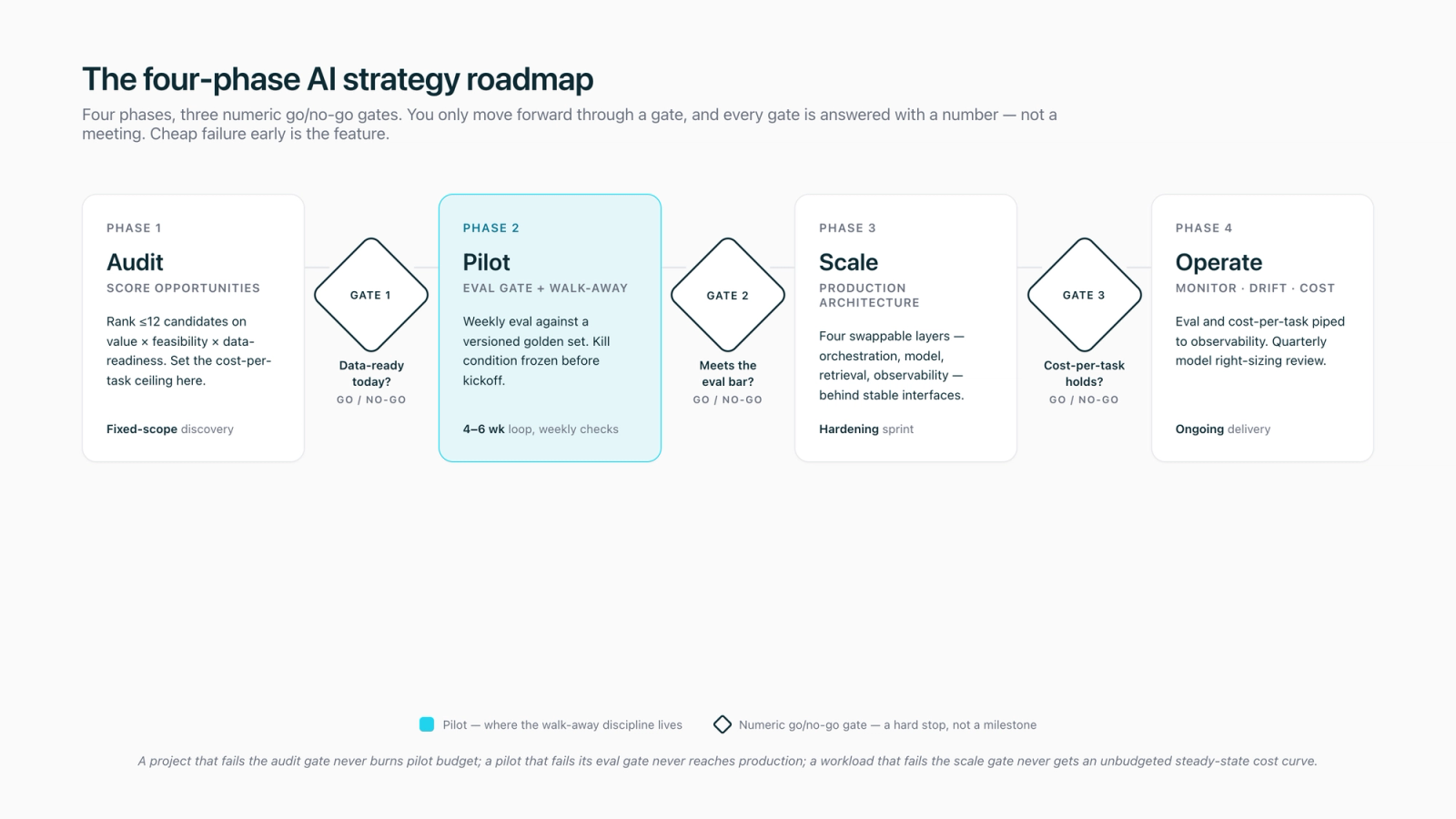
Read the diagram as a ratchet. You only move forward through a gate, and each gate has a number attached. Gate 1 asks whether the data for the top-scored opportunity exists in a queryable form right now; if not, the project drops into a data-engineering track and a different opportunity takes the pilot slot. Gate 2 asks whether the pilot hit its pre-committed eval bar on a fixed golden set; if not, the walk-away clause fires. Gate 3 asks whether the modelled cost-per-task at production volume stays inside the audit ceiling; if not, the architecture goes back to the drawing board before a single production token is spent. The phases are where the work happens. The gates are where the money is saved.
A note on cadence before the phase walk-through. We run the audit as a fixed-scope discovery with a walk-away clause, the pilot as a 4-to-6-week loop with weekly eval checkpoints, the scale phase as a production-hardening sprint, and the operate phase as ongoing delivery. No dollar tiers, deliberately: engagement shape belongs in public content; engagement pricing belongs in a conversation. What does belong here is the technical economics, the per-task numbers any buyer needs to model the decision, and those run through the roadmap below.
Phase 1, the audit: scoring opportunities by value, feasibility, and data-readiness
The audit phase produces one artifact: a scored opportunity list. Every candidate AI project gets three scores from 1 to 5. Value is the annual business impact if it works. Feasibility is how hard the model problem is given current technique. Data-readiness is the one everyone skips, and it's the one that decides sequencing: does the data already exist, labelled and queryable, or does it have to be built first? Multiply the three, sort descending, and the top of the list is your Phase 2 candidate. The maths is trivial; scoring data-readiness honestly is where engagements earn their keep.
Read the matrix top-right-first. The opportunity that ships in the first pilot is the one in the lime quadrant: high value and high data-readiness. The churn model sits top-left, high value but low data-readiness, which is why it belongs in Phase 3, no matter how loudly the board wants it. The bottom-left quadrant is a skip, not a backlog item. This single picture resolves more roadmap arguments than any other artifact we bring to a steering committee, because it makes the data-readiness constraint visible to people who were only ever shown the value axis. The deeper mechanics of scoring readiness sit inside our pillar on ai consulting services.
Two practical audit moves keep the scores honest. First, score data-readiness against a real query: can an engineer pull the training or retrieval data with a SQL statement against Snowflake or a connector into the system of record today, or is there a six-month data-pipeline project hiding behind the word "available"? Tools like dbt make the gap between "the data exists" and "the data is modelled and queryable" concrete, and that gap is usually the real Phase 1 finding. Second, cap the candidate list at twelve; an audit that returns forty opportunities has offloaded prioritisation back onto the buyer. The gate at the bottom of Phase 1 is one question: is the top candidate data-ready enough to pilot now? If yes, it goes to Phase 2; if not, the next one does, and the churn-class projects queue behind a data-engineering track.
Phase 2, the pilot: eval gates, walk-away criteria, and the 4-to-6 week loop
Here's the second opinionated take, the one consultancies almost never write down. An AI pilot without a pre-committed walk-away criterion is a sunk-cost machine, not a pilot. Every pilot we run publishes its kill condition before the first sprint: "if eval accuracy stays below 85% on the 500-case golden set after four weeks, we stop." That number is agreed at the gate out of Phase 1 and not negotiable mid-pilot. The reason this is rare is structural: a killed pilot ends the engagement, so a consultancy whose revenue depends on the next phase has every incentive to keep a failing pilot alive. An engineering-led practice treats the walk-away clause as the deliverable, because a fast, cheap no is worth more than an expensive, slow maybe.
The eval gate has to be real code against a fixed dataset, not a demo. We build a golden set of representative cases in the first week, version it, and run the model against it on every iteration with Ragas for retrieval-augmented tasks or a custom harness logged through LangSmith or Langfuse. The gate is a threshold on that set, the same number every week so progress is legible. The snippet below is the shape of the gate we ship: a tiny evaluation loop that scores a candidate against the golden set and returns a hard go/no-go.
# Phase 2 pilot eval gate. Walk-away threshold set at Gate 1, frozen for the pilot.
from ragas import evaluate
from ragas.metrics import answer_correctness
import json

WALK_AWAY_THRESHOLD = 0.85   # agreed at Gate 1 sign-off, frozen for the pilot
GOLDEN_SET = "golden_v3.jsonl"  # 500 representative cases, versioned in git

def run_gate(model_fn) -> dict:
    cases = [json.loads(l) for l in open(GOLDEN_SET)]
    preds = [model_fn(c["input"]) for c in cases]
    score = evaluate(
        dataset={"question": [c["input"] for c in cases],
                 "answer": preds,
                 "ground_truth": [c["expected"] for c in cases]},
        metrics=[answer_correctness],
    )["answer_correctness"]

    decision = "GO" if score >= WALK_AWAY_THRESHOLD else "NO-GO (walk away)"
    return {"score": round(score, 3), "threshold": WALK_AWAY_THRESHOLD,
            "n_cases": len(cases), "decision": decision}

if __name__ == "__main__":
    from candidate import answer  # the pilot model under test
    print(json.dumps(run_gate(answer), indent=2))
The 4-to-6 week loop is short on purpose. A pilot that drags past six weeks loses executive attention and starts attracting scope, and scope is how a clean go/no-go turns into a political negotiation. Inside the loop the cadence is weekly: rebuild the candidate, run the gate, log the score, decide. Most pilots that will succeed clear the bar by week three, and most that will fail are visibly stuck by week three too, which is why the weekly score matters more than the final one. If you only run the eval once at the end, you've turned a four-checkpoint loop into a single bet. The orchestration patterns behind a multi-step pilot are worth reading alongside this; our deep-dive on multi-agent orchestration patterns covers the production shapes.
Phase 3, scale: the architecture decisions that decide whether a pilot survives production
A pilot proves the model can do the task. The scale phase proves the system can do it ten thousand times a day without falling over or bankrupting the budget. These are different engineering problems, and the gap between them is where most pilots that passed Gate 2 still die. The scale-phase architecture has four layers that each carry a decision: orchestration, model, retrieval, and observability. Get the layering right and you can swap any piece without rewriting the others; get it wrong and you've built a monolith that has to be re-architected the first time a model deprecates or volume triples.
The single highest-leverage scale decision is putting the model behind an adapter. The model layer changes most often, because vendors deprecate checkpoints on short notice and a cheaper or better model ships every quarter. If your orchestration code calls the OpenAI SDK or the Anthropic SDK directly, every one of those changes is a code change across the codebase. If it calls a thin adapter, swapping GPT-5 mini for Claude Sonnet 4.6, or routing cheap cases to Gemini 3.0 Flash and hard ones to Claude Opus 4.7, is a config change. We write this as a small module rather than a heavy framework, though LangChain's model abstraction does the same job if you already use it. The adapter is half a day of work that buys the option to chase the cost curve for the life of the system.
# Thin model adapter — swap providers via config, not code.
# Routes cheap cases to a small model, hard cases to a frontier model.
import anthropic, openai

ROUTES = {
    "cheap": ("anthropic", "claude-haiku-4-5"),     # ~$0.001/1k in
    "standard": ("openai", "gpt-5-mini"),            # mid tier
    "hard": ("anthropic", "claude-opus-4-7"),        # frontier, used sparingly
}

def complete(prompt: str, route: str = "standard") -> str:
    provider, model = ROUTES[route]
    if provider == "anthropic":
        c = anthropic.Anthropic()
        m = c.messages.create(model=model, max_tokens=1024,
                              messages=[{"role": "user", "content": prompt}])
        return m.content[0].text
    c = openai.OpenAI()
    r = c.chat.completions.create(model=model,
                                  messages=[{"role": "user", "content": prompt}])
return r.choices[0].message.content# The same routing as data, not code. A model deprecation is a one-line edit.
routes:
cheap:
provider: anthropic
model: claude-haiku-4-5
cost_per_1k_in: 0.001
standard:
provider: openai
model: gpt-5-mini
cost_per_1k_in: 0.003
hard:
provider: anthropic
model: claude-opus-4-7
cost_per_1k_in: 0.015
# Gate 3 ceiling: blended cost-per-task must stay under target at real volume.The other scale decision that quietly determines survival is the retrieval layer. A pilot that hard-codes a handful of documents into the prompt tells you nothing about production, where the corpus is a hundred thousand documents and the retrieval quality, not the model, sets the answer quality. We default to pgvector when the team already runs Postgres and to Pinecone when volume justifies a dedicated service, and we treat reranking and chunking as first-class engineering, not a config afterthought. Gate 3 sits at the end of this phase: does the blended cost-per-task, measured on the real architecture at real volume, stay under the ceiling set during the audit? If not, the architecture changes before production, not after the first month's bill.
Phase 4, operate: monitoring, drift, and the cost curve nobody budgets for
Here's the third opinionated take, the one that sinks more roadmaps than any model failure. The cost that kills an AI program is the operate-phase cost curve, not the build cost. In a 2026-Q1 Ragas run on a 1,840-document corpus, a retrieval assistant scored 88% answer correctness for a single-digit-dollar evaluation spend, and that same assistant can quietly run a five-figure monthly token bill at scale. The build cost is a one-time number a CFO can sign. The operate cost is a curve that bends with adoption, and successful automations drive two-to-three times the spec'd volume, so it bends faster than anyone budgeted. The fix is to model steady-state cost-per-task in Phase 1, at $0.003 per 1k tokens times real volume, and carry that ceiling to Gate 3.
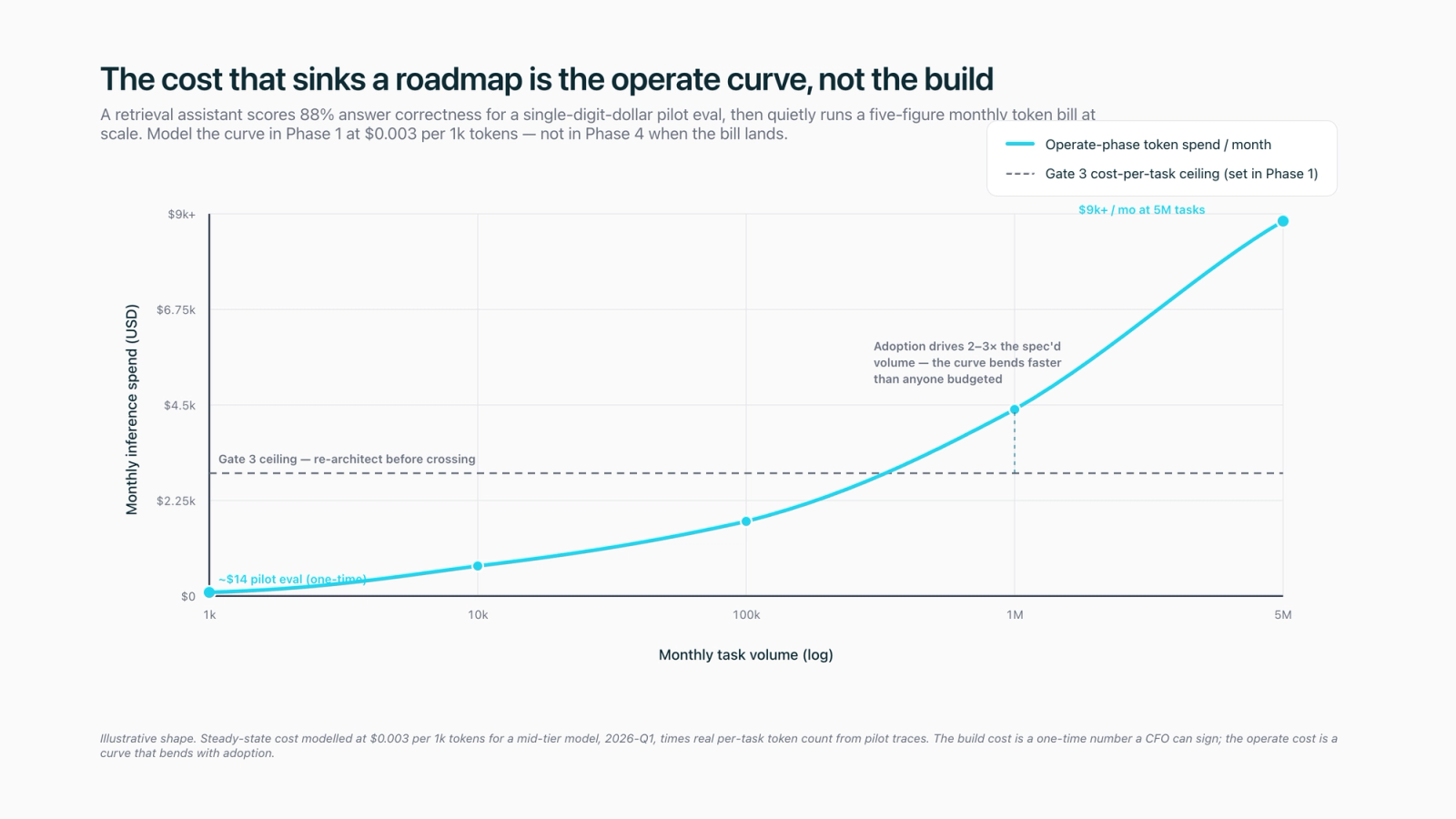
The operate phase is where three line items routinely go unbudgeted. First, drift: a model that hit the eval bar at launch degrades as its prompts age and its retrieval corpus ages, so the golden set has to be re-run on a cadence and the score watched like a production metric. We pipe eval scores and cost-per-task into the same observability stack as latency and error rate, through Langfuse and OpenTelemetry, so a quality drop or a spend spike pages someone the same day. Second, model deprecation: we've watched checkpoints deprecate on short notice; without the adapter from Phase 3 that's an emergency, with it, a config change and a re-run of the gate. Third, retrieval index maintenance: a pgvector or Pinecone index needs reindexing as documents change, weekly for active corpora, and that's compute and engineer time the build budget never included.
The single highest-leverage operate-phase cost lever, after architecture, is model right-sizing. The smallest model that clears your eval bar wins. A workload running on Claude Opus 4.7 because that's what the pilot used might run identically on Claude Haiku 4.5 or Gemini 3.0 Flash at a fraction of the per-token cost, and the only way to know is to run the cheaper model against the same golden set. We re-run that comparison every quarter because the price-performance frontier moves, and a model that was the right pick at launch is rarely still the cheapest one that meets the bar six months later. It's unglamorous work, and it's where the operate-phase economics are won. The operate phase is, in effect, continuous delivery with eval gates wired into the pipeline.
Build vs buy vs assemble: how the decision changes at each roadmap phase
The build-vs-buy decision is not a single call made once at the start of a roadmap. It's a call you re-make at every phase, because the right answer flips as the workload moves from pilot to production. Buying is usually right in the pilot, when speed-to-signal beats unit cost. Assembling, gluing managed pieces together, is usually right at first production. Building, owning the stack, becomes right only at sustained scale or under a compliance constraint a vendor can't satisfy. Teams that pick one posture and hold it across all four phases either over-build a pilot that should have used an off-the-shelf API, or under-build a production system now hostage to a vendor's pricing.
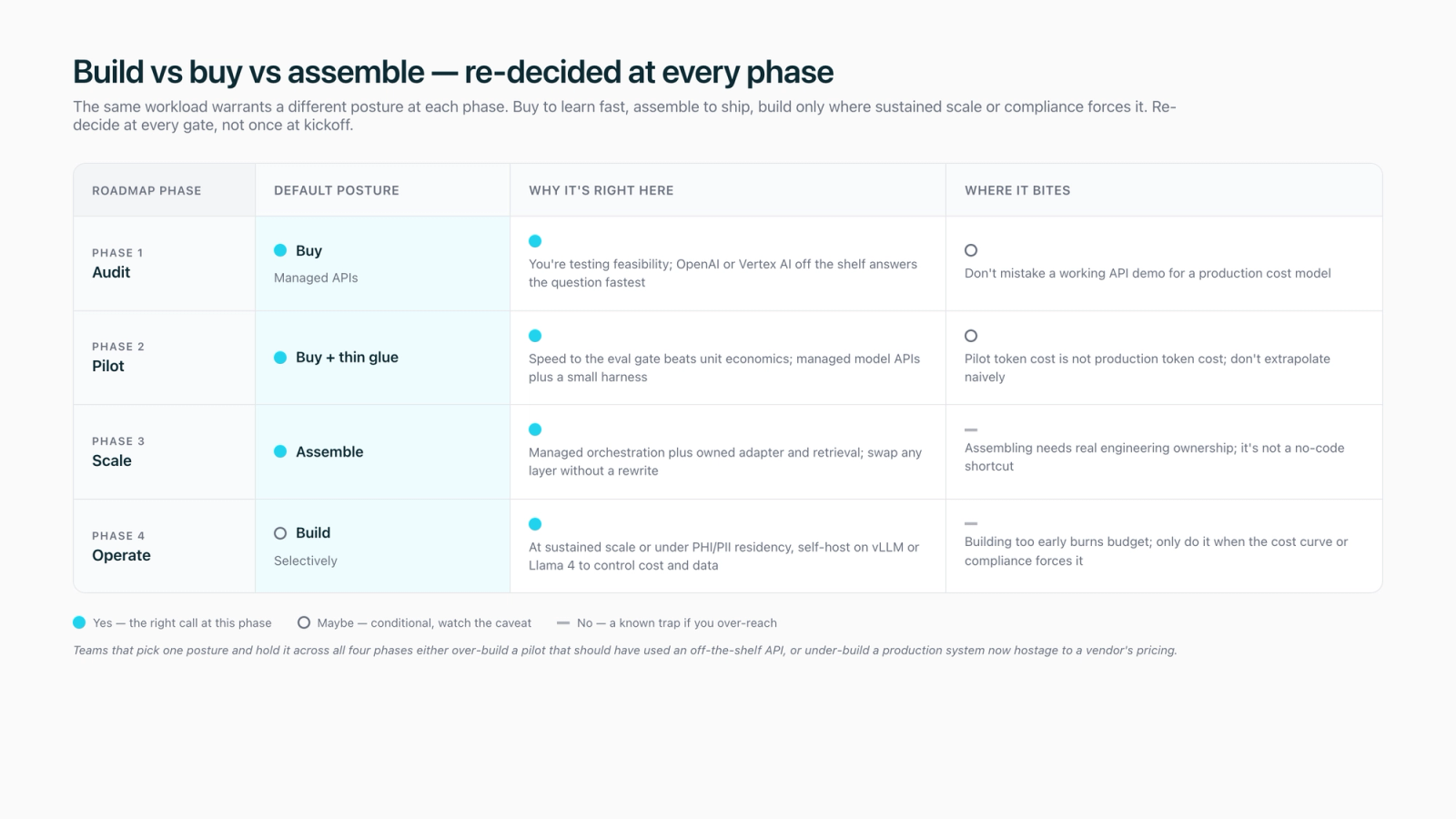
| Roadmap phase | Default posture | Why it's right here | Where it bites |
|---|---|---|---|
| Audit | Buy (managed APIs) | You're testing feasibility; OpenAI or Vertex AI off the shelf answers the question fastest | Don't mistake a working API demo for a production cost model |
| Pilot | Buy + thin glue | Speed to the eval gate beats unit economics; managed model APIs plus a small harness | Pilot token cost is not production token cost; don't extrapolate naively |
| Scale | Assemble | Managed orchestration plus owned adapter and retrieval; swap any layer without a rewrite | Assembling needs real engineering ownership; it's not a no-code shortcut |
| Operate | Build (selectively) | At sustained scale or under PHI/PII residency, self-host on vLLM or Llama 4 to control cost and data | Building too early burns budget; only do it when the cost curve or compliance forces it |
The assemble posture is the one most roadmaps underweight, and it ages best. Pair a managed orchestration layer with an owned model adapter and retrieval layer, glue them behind stable interfaces, and you get the speed of buying with the optionality of building. When a model deprecates, you swap behind the adapter; when token costs drop, you re-route; when a compliance requirement lands, you self-host one layer without touching the rest. The build-it-all posture only earns its keep at the operate phase, under a hard constraint: sustained volume where managed pricing crosses the cost of running your own inference on vLLM, or a data-residency rule. Outside those two cases, assembling beats building on every axis a CFO cares about.
The economics of an AI strategy roadmap: cost-per-task, pilot burn, and ROI timing
The economics conversation is where ai strategy consulting earns or loses a CFO's trust. Hours-saved framing doesn't survive a finance review; cost-per-completed-task does. The model needs four inputs: task volume per month, the cost-per-task baseline, the cost-per-task after automation, and the build plus ongoing cost. Monthly saving is volume times the unit-cost difference; payback in months is build cost divided by monthly saving. Finance respects that simple model far more than a narrative about strategic enablement. The discipline is deriving the after-automation unit cost honestly, which means modelling tokens, retrieval, and observability, not just the headline API price.
| Cost component | Driver | Typical shape per task | Lever to pull |
|---|---|---|---|
| Inference tokens | Model tier x token count x volume | Dominant line at scale | Right-size the model against the eval bar |
| Retrieval query | Vector store reads, reranking | Small but volume-sensitive | pgvector over a managed tier when Postgres exists |
| Orchestration compute | Workflow runs, retries | Usually rounding error | Cap LLM-call retries at 2-3, dead-letter the rest |
| Observability + on-call | Traces, eval re-runs, drift watch | Amortised across all tasks | Budget at Phase 1, not as an afterthought |
| Index maintenance | Reindexing cadence | Periodic compute + engineer time | Weekly for active corpora, monthly for archives |
Two timing realities the economics have to respect. First, ROI timing depends almost entirely on volume, because the payback formula is dominated by the volume term. A high-volume workflow, tens of thousands of tasks a month, pays back its build in weeks; a low-volume one can take a year on the same unit savings. That's why the audit's value axis has to be paired with a real volume estimate before a project enters the roadmap. Second, pilot burn is intentionally tiny and should stay that way. A pilot that evaluates a candidate against a golden set for a few dollars of API spend is doing its job; one that's somehow spending production money to prove a point has skipped the eval-gate discipline and is already drifting toward the sunk-cost failure mode.
How engineering-led AI strategy consulting differs from a management-consulting engagement
The phrase that resonates on this SERP, makers not management consultants, isn't just positioning; it describes a different delivery model. A management-consulting AI engagement optimises for the quality of the recommendation and hands off execution. An engineering-led engagement optimises for the working system and treats the recommendation as a by-product of building it. The difference shows up in the deliverable, the incentive structure, and what happens when a pilot fails. Both have a place, but for a buyer who needs a roadmap an engineering team can run, the distinction is the whole decision.
| Management-consulting engagement | Engineering-led engagement | |
|---|---|---|
| Primary deliverable | A recommendation deck and a maturity score | A sequenced, gated roadmap plus working pilot code |
| Who writes the eval gate | Usually no one; success is qualitative | Engineers, as code against a versioned golden set |
| Incentive on a failing pilot | Keep it alive; the next phase is the revenue | Fire the walk-away clause; a fast no is the value |
| Cost model depth | Year-two ROI, hours saved | Cost-per-task at real volume, per-token math |
| Tool decisions | Vendor-neutral, deferred to implementation | Named picks with swap paths, made in the open |
| Hand-off | Execution handed to a separate team | The team that specced it builds and operates it |
The clearest tell is the eval gate. A management-consulting engagement rarely writes one, because writing a falsifiable success criterion as code is an engineering act, and because a hard gate creates the possibility of a documented failure. An engineering-led engagement insists on it, because the gate makes the roadmap honest. The same logic runs through the build-vs-buy posture, the cost model, and the named-tool decisions: an engineering-led practice makes the calls in the open, with numbers attached, because it lives with them in production. That accountability is what a buyer pays for when they choose makers over slide decks, and it's why the roadmap in this guide ships as a runnable artifact, not a narrative.
The AI strategy roadmap template: a phase-by-phase checklist you can run on Monday
Here's the artifact the rest of the SERP withholds: the roadmap as a checklist you can run yourself. We use a version of this in every discovery, and the ordering is load-bearing, since skipping ahead is the most common failure mode. Run it top to bottom, and treat each gate as a hard stop. If you can't answer a gate question with a number, you're not ready to pass it.
| Phase | The artifact you produce | The gate question (answer with a number) |
|---|---|---|
| 1. Audit | A ranked list of <=12 opportunities scored on value x feasibility x data-readiness, with a cost-per-task ceiling | Is the top candidate's data queryable today? (yes / no) |
| Gate 1 | Data-readiness sign-off | Can an engineer pull the data with one query now? |
| 2. Pilot | A versioned golden set, an eval harness, and a frozen walk-away threshold | Does the score clear the threshold on the golden set? |
| Gate 2 | Eval-bar sign-off (the walk-away clause) | Score >= threshold after <=6 weeks? Else stop. |
| 3. Scale | A four-layer architecture with a model adapter and a real retrieval layer | Does blended cost-per-task at real volume stay under the ceiling? |
| Gate 3 | Production cost sign-off | Cost-per-task <= the Phase 1 ceiling at projected volume? |
| 4. Operate | Cost + drift monitoring, a quarterly model right-sizing review, an index-upkeep cadence | Is quality holding and is the cost curve inside budget this quarter? |
Run that table as your roadmap and you've replaced a strategy deck with an executable plan. Each phase produces one artifact, and each gate is a numeric hard stop: the first stops data-hungry projects before they burn pilot budget, the second kills failing pilots fast, the third stops a workload whose cost-per-task doesn't survive production. Three numeric gates, one artifact per phase, something an engineering team can pin to a wall and run.
One closing note. The gates only work if the numbers are set before the work starts and frozen while it runs. A walk-away threshold negotiated mid-pilot is no threshold; a cost-per-task ceiling raised after the build is no ceiling. The value of an engineering-led roadmap is that it makes the hard decisions cheap by making them early and numeric. That's the shape of engagement we deliver: a fixed-scope audit with a walk-away clause, a gated pilot, a hardened scale build, and continuous operate-phase delivery, with the economics modelled in the open from day one.
FAQ on AI strategy consulting and roadmaps, in the buyer's vocabulary
What is ai strategy consulting in plain language?
It's the work of deciding which AI projects an organisation runs, in what order, against which numeric success and kill criteria, and with what build-vs-buy posture per project. The output that matters is a sequenced roadmap with go/no-go gates an engineering team can execute, not a maturity score or a list of hypothetical use cases. An engineering-led practice ships it as a runnable artifact: a scoring matrix, eval gates, an architecture, and a cost-per-task model.
What does an ai strategy consulting ROI model actually look like?
The ai strategy consulting ROI model has four inputs: monthly task volume, the cost-per-task baseline, the cost-per-task after automation, and the build plus ongoing cost. Monthly saving is volume times the unit-cost difference; payback in months is build cost divided by monthly saving. ROI timing is dominated by volume, so a high-volume workflow pays back in weeks while a low-volume one can take a year on the same unit savings. Hours-saved framing doesn't survive a CFO review; cost-per-completed-task does.
How is ai strategy consulting cost structured, and what should I expect?
On ai strategy consulting cost, the public answer is engagement shape rather than dollar tiers: a fixed-scope audit with a walk-away clause, a 4-to-6-week pilot with weekly eval gates, a scale-phase hardening sprint, and ongoing operate-phase delivery. The technical economics that drive the buying decision are the per-task numbers: budget steady-state cost at roughly $0.003 per 1k tokens for a mid-tier model times your real volume, and remember the operate-phase token bill, not the build, is usually the dominant line.
What does the ai strategy consulting evaluation gate measure?
The ai strategy consulting evaluation gate is a threshold on a fixed, versioned golden set, checked as code rather than in a demo. For retrieval-augmented tasks we use Ragas and log runs through LangSmith or Langfuse; the gate is the same number every week so progress is legible. The walk-away criterion, for example 85% on a 500-case set after four weeks, is agreed before the pilot and frozen while it runs. A pilot without a pre-committed evaluation gate is a sunk-cost machine, not a pilot.
Can you give concrete ai strategy consulting examples of good and bad sequencing?
The clearest ai strategy consulting examples come from sequencing. A churn-prediction model that needs eighteen months of clean event data is a Phase 3 project even though it scores highest on value, because it scores low on data-readiness; sequencing it first is the classic stall. A support-deflection assistant built on already-queryable data is a better first pilot even at lower headline value, because it clears an eval gate in weeks. Score every candidate on value times feasibility times data-readiness before it enters the roadmap, and the sequencing argument resolves itself.
Is this ai strategy consulting guide a substitute for an engagement?
This ai strategy consulting guide ships the artifact, the four-phase roadmap template with its gates, so you can run the audit-pilot-scale-operate loop yourself. What an engagement adds is the discipline of doing it under accountability: an outside team that scores data-readiness honestly, writes the eval gate as code, holds the walk-away clause when a pilot fails, and models the operate-phase cost curve before the bill arrives. The template is the map; the engagement is having makers walk it with you.
How does build vs buy change across the roadmap?
It flips by phase. Buy managed APIs from OpenAI, Anthropic, or Vertex AI in the audit and pilot, where speed to the eval gate beats unit cost. Assemble at scale, pairing managed orchestration with an owned model adapter and retrieval layer so any piece swaps without a rewrite. Build, meaning self-host on vLLM or Llama 4, only at the operate phase under a hard constraint: sustained volume where managed pricing crosses your own inference cost, or a data-residency rule. Re-decide the posture at every gate, not once at kickoff.
Ready to sequence your AI roadmap with eval gates instead of slideware?
We score your opportunity list, write the gates as code, run a 4-to-6-week pilot with a walk-away clause, and model the cost-per-task before you commit a single production token. Makers, not management consultants.