How to Build a Messaging App Like Signal — Encrypted Chat App Architecture & Scope (2026)
How to build a secure messaging app like Signal — end-to-end encryption, key exchange, infrastructure choices, and a development roadmap with costs.
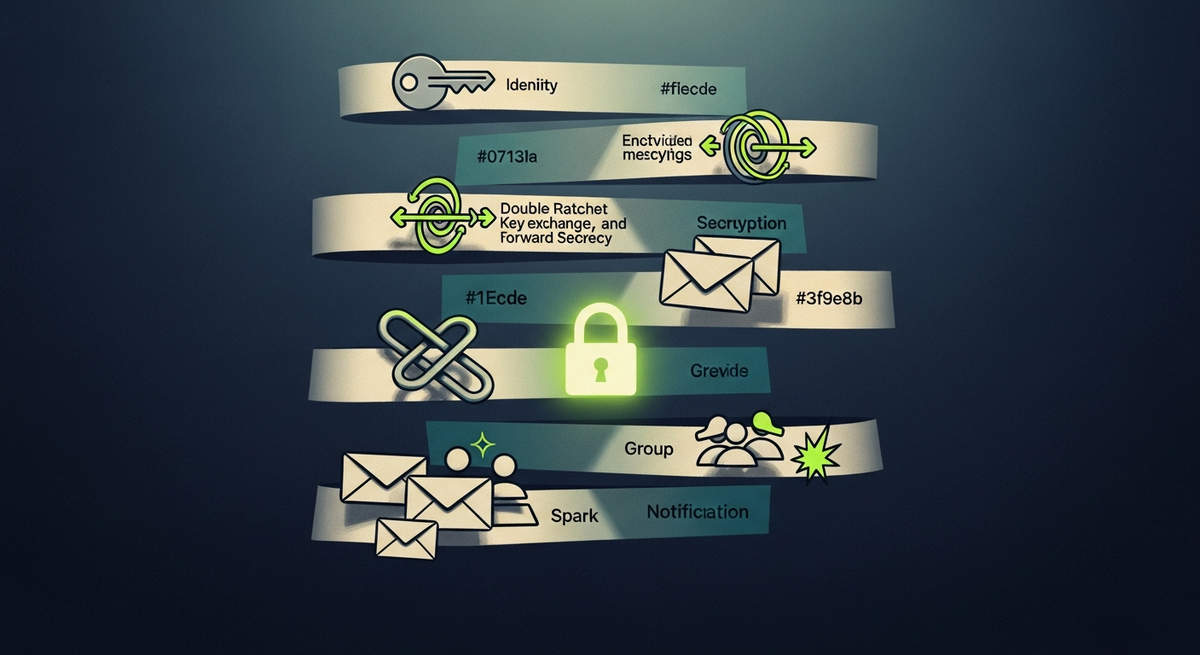
How to make messaging app like Signal is one of the most expensive questions in mobile engineering. The protocol is open, the spec is roughly 30 pages, and a serviceable demo can be wired up in a weekend. A production build that protects real users from real adversaries is closer to 16-24 weeks with a 5-engineer team and an $80K-250K floor for the MVP alone. The gap between the two is where most clone projects fail.
Our team has shipped E2EE chat features across Flutter and React Native clients, integrated libsignal through platform channels, and walked clients through threat-model exercises before a line of cryptographic code gets written. We've also turned down builds where the budget and the threat model didn't match. This guide is the operator version of that conversation. What Signal-style architecture actually requires, what tech stack we'd pick in 2026, and what a Signal-grade messaging app development company has to deliver beyond the protocol itself.
If you came here looking for a five-week MVP quote, this is the wrong page. If you want to know why every honest scope range starts at six figures and where the money goes, read on.
What a Signal-style messaging app actually is
An end to end encrypted messaging app means more than "messages are encrypted in transit." Five properties define a Signal-grade system, in order of how hard each is to ship correctly. First, forward secrecy and post-compromise security via the Double Ratchet. Every message uses a fresh symmetric key, so a stolen device key can't decrypt past messages and a future compromise can't decrypt earlier ones. Second, asynchronous key agreement via X3DH, so Alice can send Bob a first message while Bob is offline.
Third, sealed sender: the server routes a message without knowing who sent it, hiding metadata that the cryptography alone leaks. Fourth, sealed groups: group membership and group identifiers aren't visible to the server. Signal moved to that model in 2020. Fifth, the polish layer of disappearing messages, screen-security, contact discovery via SGX or private-set intersection. Cheaper E2E offerings (Sendbird E2EE, Virgil Security, Matrix's Olm/Megolm) implement the first one or two properties cleanly. They're fine products for some markets. They are not Signal.
Knowing which of the five your product actually needs is the first scoping conversation we run. A B2B compliance chat for a regulated industry may only need property one with audit logs. A whistleblower platform needs all five plus key transparency. The price tag swings by 3x on that single decision.
Signal app architecture: the 6 layers that matter
When we sit down to plan how to make messaging app like Signal for a client, we draw six boxes on the whiteboard before talking about screens or features. Each layer has a named algorithm, a reference implementation, and a category of bugs that will cost you if shipped wrong. Our Flutter mobile app development guide walks through the client-side architecture we use.
Identity and key registration (X3DH)
X3DH (Extended Triple Diffie-Hellman) establishes a shared secret between two parties who may not be online simultaneously. Each user publishes an identity key, a signed prekey rotated weekly, and a stack of one-time prekeys to the server. The sender fetches a bundle, performs three or four Diffie-Hellman operations against the recipient's keys plus their own, and derives the initial session key.
Alice -> Server: registers (IK_A, SPK_A, [OPK_A_1...n])
Bob   -> Server: registers (IK_B, SPK_B, [OPK_B_1...n])

# Alice initiating session with Bob
Alice fetches Bob bundle: (IK_B, SPK_B, OPK_B_i, signature(SPK_B by IK_B))

verify signature(SPK_B by IK_B)            # bail if invalid
EK_A = generateEphemeral()
DH1 = DH(IK_A, SPK_B)
DH2 = DH(EK_A, IK_B)
DH3 = DH(EK_A, SPK_B)
DH4 = DH(EK_A, OPK_B_i)                    # optional, if pre-key present

SK = KDF(DH1 || DH2 || DH3 || DH4)         # shared secret seeds double ratchet

Alice -> Bob: initial message
  header: (IK_A, EK_A, OPK_B_i)
  ciphertext: encrypt(SK, plaintext)
The math is in the published Signal X3DH spec. The implementation work is in correctly rotating prekeys, handling the one-time-prekey exhaustion edge case, and refusing to send when the server returns a tampered bundle. Reference implementations live in libsignal-protocol-c, libsignal-client-rust, and libsignal-protocol-java. We do not recommend writing X3DH from scratch for a commercial product. Use the audited libraries and own only the integration code.
Session establishment (Double Ratchet)
Every message advances two ratchets: a Diffie-Hellman ratchet when a new DH key is included in the header, and a symmetric KDF chain that derives per-message keys. The result is per-message uniqueness, immediate discard of past keys, and bounded compromise. A future device theft can read what's on disk, never what came before. The published Signal Double Ratchet spec is around 30 pages.
A production-grade implementation is closer to 3,000 lines of cryptographic code that needs constant-time operations, side-channel resistance, and exhaustive test vectors. Our default is to keep this layer inside Signal's audited libraries (libsignal-client-rust shipped via FFI, or the Java/Kotlin and Swift bindings on each platform) and never touch the primitives directly in product code.
Message transport (sealed sender, no metadata)
After a session is established, Signal encrypts the sender's identity inside the message envelope so the server only sees the recipient. To prevent spam, the server validates a short-lived sender certificate without learning who issued it. The cryptographic primitive is straightforward; the operational work is real.
Sealed sender adds roughly 15-20% to protocol code volume and 25% to the test surface, in our experience on two prior builds. You also need a certificate-authority service that issues sender certificates without logging who they go to. That's an entire backend subsystem on its own. Skip it and your "E2EE" app still leaks who-talks-to-whom social graphs to anyone with subpoena access to the server.
Multi-device sync (linked devices, not multi-device crypto)
Signal does not run "multi-device cryptography" the way iMessage does. Each linked device gets its own identity key and its own set of sessions. When you send a group message from your phone, your phone encrypts it once per recipient device. Adding a second device to an existing identity without breaking forward secrecy is the single hardest engineering problem in this architecture.
We budget 3-5 weeks of senior engineering for the link-device flow on a Signal-style build, even with libsignal handling the primitives. The QR-code linking ceremony, message history transfer (or refusal to transfer), and revocation of stolen linked devices each have their own edge cases. Get this wrong and you ship a chat app that loses messages every time a user upgrades a phone.
Group messaging (sender keys vs pairwise)
Signal uses pairwise encryption inside groups: every group message is encrypted independently to each member. That scales linearly with group size. At 1,000 members, a single message becomes 1,000 ciphertexts. Bandwidth and battery costs follow. The alternative, MLS (Messaging Layer Security, RFC 9420), uses a shared group key with logarithmic ratchet trees. WhatsApp moved to MLS in 2024 for large communities.
Our recommendation for new builds in 2026 is to ship pairwise for groups under 256 members and plan an MLS migration path for anything beyond that. Mixing the two in one app is possible (libsignal-client now exposes MLS primitives) but adds about 4 weeks of integration work and a second audit pass.
Offline and push (notification security)
APNS and FCM are operated by Apple and Google. Anything you put in a push payload, they can read. Signal-style apps therefore send wake-up pings only. The actual ciphertext arrives over an authenticated WebSocket session that the client opens to your server after the OS wakes it. That's a small change with large implications: your backend has to hold a message queue per user, handle reconnection storms, and degrade gracefully when carriers throttle long-lived connections.
On iOS, the situation is harder because background-fetch budgets are tight. Signal's own iOS app uses NSE (Notification Service Extension) to decrypt messages inside a separate process. That extension has a 30-second wall-clock budget and a 24MB memory limit. Our delivery team treats the NSE as its own micro-app with its own performance budget.
Tech stack: what we'd actually build with in 2026
There is no single answer to how to make messaging app like Signal in stack terms. Choice depends on team composition, target platforms, and whether you need self-hostable inference for AI features. Below is the default we'd quote for a new client asking about chat app development today, with named alternatives for the three most common deviations.
Client: Flutter (why) and alternatives
Our default mobile client is Flutter, with platform channels into libsignal-client-java on Android and libsignal-client-swift on iOS. The cryptographic surface stays inside Signal-audited code; the Dart layer handles session management, key storage, contact UI, and the chat list. We've shipped this pattern on two prior builds and the binding work runs 4-6 weeks of senior mobile engineering on its own.
When Flutter is the wrong call: if you already have a React web app and need a chat tab inside it, React Native via libsignal-client-rust FFI is the saner choice. If you need first-day CallKit and ARKit integrations, native Swift on iOS and native Kotlin on Android still win. Pure Dart bindings (the older flutter_sodium path) we no longer recommend; package maintenance has been intermittent since late 2023 and the X3DH layer is not something to write twice.
Backend: WebSocket server, message queue, push gateway
Signal's open-source server is written in Java. For new builds we lean Rust (using tokio and axum) or Go, both of which give us cleaner concurrency primitives for the long-lived WebSocket sessions a Signal-style app demands. The queue is Redis Streams or NATS JetStream. Postgres handles the relational side (registration records, sealed-sender certificates, prekey bundles). We avoid full message persistence on the server. Undelivered envelopes live in the queue with a 30-day TTL and are deleted on receipt.
Push fan-out is its own service. APNS on iOS, FCM on Android, both delivering wake-up notifications with no payload. The push service holds APNS and FCM tokens (rotated frequently), maps them to user UUIDs, and intentionally has no access to message content. That last sentence is the one your security auditor will ask for proof of.
Crypto layer: libsignal vs Olm/Matrix vs build-your-own (don't)
Three honest options. libsignal-client is the reference, MIT-licensed, with bindings in Java, Swift, and Rust. It is the only stack that runs the original Signal Protocol with the same audited code path. Olm and Megolm, from the Matrix project, ship a different protocol with federation built in; it's appropriate when you want decentralized routing and accept a different threat model. Writing your own primitives is the path used by exactly one commercial product we'd name (iMessage), and Apple has more cryptographers than your roadmap probably justifies.
Storage: encrypted SQLite, no plaintext on server
On-device storage uses SQLCipher (AES-256 with a key derived from the device keychain via PBKDF2 or Argon2id). The user passphrase, if any, layers on top through Argon2id with high memory cost. On the server side, message bodies never appear in plaintext; the queue holds opaque envelopes that the recipient client decrypts. Backups, if you offer them, must be client-side encrypted before upload. Apple's iCloud backup is plaintext from your app's perspective, which is why Signal explicitly excludes itself from it.
Cost and timeline: what it actually takes to build messaging app like Signal
Below is the scope range we'd quote a client today for a Signal-style messaging app development project. Numbers reflect blended senior-engineer day rates and a 5-person team (2 mobile, 1 backend, 1 cryptography lead, 1 product/QA). Ranges are wide because the threat model drives 40% of the variance.
| Phase | Timeline | Cost range | What's included |
|---|---|---|---|
| Threat-model audit | 2-3 weeks | $3K-15K | Who you're protecting against, jurisdictional review, library choice sign-off |
| MVP build | 12-16 weeks | $80K-250K | iOS + Android via Flutter, 1:1 chat, X3DH, Double Ratchet, sealed sender, push |
| Production-grade | 24-32 weeks | $250K-600K | Adds groups, multi-device link, disappearing messages, contact discovery, screen-security |
| Independent crypto audit | 4-6 weeks | $30K-80K | Trail of Bits, NCC Group, or Cure53 review of code paths and threat model |
| Voice and video | 10-14 weeks | $60K-150K | SRTP + DTLS-SRTP, group calls, jitter buffer tuning, TURN infra |
| Continuous engagement | monthly | $10K-25K | Security patching, abuse pipeline, SDK upgrades, key-rotation ops |
What drives the spread inside each row. For the MVP, the biggest cost lever is whether you reuse the Signal Foundation's open-source server (saves 6-8 weeks) or run a custom backend with sealed-sender certificates and an abuse pipeline you control (adds the same). For the production-grade tier, the cost is dominated by multi-device link flows and key transparency infrastructure, both of which are easy to underestimate by a factor of two.
We start every Signal-style engagement with a $3K discovery audit. That two-week exercise produces a threat-model document, a stack recommendation, and a fixed-price pilot scope. The pilot itself lands in the $10K-25K continuous range only when the build is small (a B2B chat tab inside an existing app, say). A clean-room Signal clone never fits inside the pilot envelope; it lands in the MVP row above. If a vendor quotes you $30K for that build, ask which of the six layers they're skipping.
Cryptography is a non-negotiable line item. If you cut the protocol audit to save eight weeks, you do not have a Signal-style messaging app. You have a leak with a UI.
Compliance and security audit: what an end to end encrypted messaging app must clear
Encrypted messaging is the most regulatorily contested category in mobile. GDPR and CCPA push you toward metadata minimization: collect no PII you don't need, retain nothing past delivery, allow account deletion that wipes server-side state in a verifiable way. The technical work to support that includes a tombstone protocol for deleted accounts and a documented data-retention schedule that an auditor can run queries against.
Independent cryptographic audit is non-negotiable for anything claiming Signal-grade. Three firms we'd shortlist: Trail of Bits (strong on Rust and protocol review), NCC Group (deep mobile platform expertise), and Cure53 (the firm Signal itself has used). Budget $30K-80K and 4-6 weeks. The deliverable is a report you can hand to enterprise buyers and to journalists. Skipping this step is the single most common cost-cut in clone projects, and the one that ends careers when a CVE lands.
App-store policies add a third axis. Apple requires Export Compliance documentation for any app using non-exempt cryptography; the standard answer is an annual self-classification report to the US BIS. Google Play is friendlier on crypto but stricter on data-safety declarations. Both stores will reject apps that claim E2EE in marketing copy but hold key escrow on the server. Our delivery team writes the data-safety form alongside the code, not after submission.
Threat-model documentation closes the loop. Who are you protecting against, opportunistic attackers, criminal groups, or nation-state actors? What capabilities do they have? What's out of scope (compromised endpoints, malicious linked devices, hardware implants)? A two-page threat-model doc costs a week of senior engineering time and saves a quarter of work later when the audit firm asks the same questions.
AI features for modern messaging: what makes sense and what doesn't
The simplest rule: if the AI runs on the server, your E2EE claim is dead. The moment plaintext leaves the device for inference, you've built a system Signal would not call Signal. Every credible AI feature in an encrypted chat app in 2026 runs on-device or not at all.
On-device options are now real. Apple Intelligence (3B-parameter foundation model on A17 Pro and later) handles summarization, translation, and tone rewriting inside the secure enclave. Gemini Nano on Pixel and recent Samsung devices runs a similar workload through AICore. For cross-platform we've shipped Phi-3.5 mini (3.8B) and Gemma 3 270M as quantized GGUF models inside the app bundle, with llama.cpp or mlc-llm as the runtime. Latency on a modern phone is 200-600ms for a typical summarization prompt.
What we won't ship: server-side translation of E2EE messages, server-side spam filtering on message bodies, or server-side AI summaries of chat threads. Each one breaks the encryption guarantee. Federated learning is a workable middle path for things like typo correction (gradients leave the device, plaintext does not) but it adds significant infra complexity and is not worth it for an MVP.
When to hire a messaging app development company vs. build in-house
Build in-house when you already have a cryptography hire on staff, a budget for an 18-month roadmap, and a product that depends on chat being a strategic moat (think a regulated-industry platform where the messenger is the differentiator). Hire a messaging app development company when chat is a feature inside a larger product, when time-to-pilot matters more than long-term IP ownership, or when you need senior mobile crypto talent for a 6-month window without committing to a full-time hire. For a related deep-dive on model trade-offs see our best AI chatbots guide.
Mixed models work too. We've delivered Signal-style chat features where our team owned the crypto integration and the client's internal team owned the product surface. That pattern keeps the highest-risk work (X3DH integration, Double Ratchet plumbing, audit prep) inside a team that's done it before, and the highest-value work (product UX, growth, business logic) inside the team that owns the customer relationship.
If you're evaluating partners, our $3K discovery audit produces a written threat model, a stack recommendation with named libraries, and a fixed-price pilot scope. That document is yours regardless of whether you engage us for the build. We've found that a serious audit kills about a third of "clone Signal" projects before they start, and the clients who proceed do so with a roadmap that doesn't collapse in month four.
If chat is one of several features inside an AI-powered product, our ai-chatbot-development practice and mobile-app-development team work the build together. The crypto layer slots beneath whichever conversational AI surface you're building. Both teams use Claude, OpenAI, and open-weight models on the inference side, and both have shipped on-device LLM features inside Flutter and React Native shells.
How to make messaging app like Signal: FAQs
Can I clone Signal directly?
Signal's client and server code are AGPL and GPL respectively. You can fork them, but you cannot use the Signal name, the Signal trademark, or the Signal Foundation's central server. Existing federated or independent forks include Session (Loki Foundation), Molly (Android-only hardened fork), and SimpleX. Building your own server is mandatory; cloning the client UI is legally permitted but rarely the right product decision. If you are exploring how to make a messaging app at MVP scope only, our scoping checklist below lists the minimum-viable cuts that keep cryptography correct while trimming the surface area.
How long does it take to build a messaging app like Signal?
A 1:1 chat MVP using libsignal bindings, iOS and Android via Flutter, ships in 12-16 weeks with a 5-person team. Production-grade (groups, multi-device, disappearing messages, voice/video) lands at 24-32 weeks. Anything faster is either using a managed E2EE SDK and calling it Signal-grade or skipping audit and sealed-sender work.
Is Signal Protocol open source?
Yes. The Signal Protocol specifications (X3DH, Double Ratchet, Sealed Sender) are published under a permissive license; the reference libraries libsignal-protocol-c, libsignal-client-rust, and libsignal-client-java are MIT-licensed. WhatsApp, Google Messages (RCS E2EE), and Facebook Messenger Secret Conversations all use Signal Protocol under the hood. Adoption past 2 billion users is itself a strong audit signal.
What's the difference between Signal Protocol and Matrix?
Signal Protocol is a centralized protocol designed for a single trusted server (yours). Matrix is a federated protocol where many independent servers exchange messages, and its Olm and Megolm primitives are similar in spirit to X3DH and Double Ratchet but with a different threat model around server compromise. Pick Signal Protocol when you want a single-tenant E2EE messenger. Pick Matrix when you want federation across organizations and accept that group membership leaks to home servers.
What's the realistic cost to build an encrypted messaging app?
$80K-250K for an MVP, $250K-600K for a production-grade build, plus $30K-80K for an independent audit. Voice and video add $60K-150K. Continuous security operations after launch run $10K-25K per month. Cheaper bids almost always skip sealed-sender, multi-device sync, or the audit. The Reddit threads complaining about Signal clones that broke in production usually map to those exact shortcuts.
Can on-device AI features coexist with E2EE?
Yes, as long as inference stays on the device. Apple Intelligence, Gemini Nano, Phi-3.5 mini, and Gemma 3 270M are all viable for in-app summarization, translation, and tone-rewriting features. Server-side inference on plaintext messages breaks the encryption contract; there is no honest "both" answer here. Our delivery team scopes AI features inside the on-device runtime budget from the start.
Signal-style chat is the highest-skill mobile cryptography work in commercial production today. The protocol is open, the libraries are audited, and the spec fits on a long flight. The implementation work of sealed-sender certificates, multi-device link flows, NSE budgets, audit prep, and threat-model documentation is what separates a $30K clone that breaks in month two from a $250K MVP that holds up under scrutiny. If you want a written threat model and a fixed-price scope on your build, the $3K discovery audit is the right first step. We'll tell you which of the six layers you actually need.


The Best AI Chatbots in 2026: A Practitioner Comparison
Top AI chatbots in 2026 compared by workload. Coding, research, writing, long-context, multimodal, cost — practitioner picks with current benchmarks.
Flutter Mobile App Development: A 2026 Production Field Guide
How we structure Flutter projects at GetWidget in 2026: feature-first layout, Riverpod defaults, Dart 3 records and sealed classes, Material 3 theming, the 200-line widget rule, performance diagnosis, CI/CD pipelines, and the production pitfalls that bite teams after launch.
AI in Banking — Use Cases, Named Bank Precedents, and Eval Methodology (2026)
How AI is used in banking — fraud detection, credit scoring, customer service automation, RegTech, and the use cases banks are deploying right now.
Is Cursor AI Worth It? An Honest Review After 6 Months in Production
Six months of Cursor in production: 2026 update covering Composer 2, background agents, Hooks, MCP, the June 2025 pricing reset, real cursor vs Copilot team cost math, and where Continue.dev fits as the open-source alternative.